Showing posts with label visual novels. Show all posts

Tuesday, August 31, 2021

The legacy of Princess Maker 2

 As someone who helped write a game about parenting, I have opinions about parenting games. It's difficult to combine fiddly statistics with a narrative that gives a good simulation of both the day-to-day parenting decisions and an occasional event that feels like a pivotal moment, like how much dessert to give your child vs, deciding if you're going to force your child to take piano lessons. I'm on a quest to find and review all the parenting games that I can! I want to find the best parenting games and learn from their game design.

The first parenting game I ever played was Princess Maker 2 (1996). It's set in a medieval fantasy world where you become guardian of an 11-year-old orphan. You decide her schedule, where you can pay for her to attend expensive classes or she can make money by working. She can learn etiquette so she can properly greet the king's concubine, or she can work on a farm improving her stamina and earning money. She can study art and enter the yearly art contest, or hone her spiritual sensitivity while work in the graveyard. She can go to church and be pious, or work in a sleazy bar! Your daughter can also go out adventuring and either talk to or beat monsters she encounters in four different areas. I remember trying out lots of different ways of raising my child. Essentially, this game is a stat-cruncher and it's hard to feel connected to your daughter in the game. She seems more like a collection of numbers than a real person. Your choices for her schedule definitely affect her ending occupation and role in society, and there are many, many different endings. I would say that it's a classic that introduced parenting as a worthy game narrative to a western audience. The sequels were only recently localized and made available in the United States, although fans agree that Princess Maker 2 is the best of the series. You can play the original localization that wasn't sold in the US, or you can buy the remake on Steam.

Ciel Fledge: A Daughter Raising Simulator is a direct descendent of the Princess Maker games, but there is a science-fiction setting and more things to fiddle with. You decide what classes your daughter should take and they raise various stats that she needs, and I think they affect the endings. Your daughter can make a lot of friends, and there is a mood system where your daughter will get depressed if she's too stressed out. Unfortunately, I didn't really like this game. Learning about how to battle felt like reading a textbook, and the writing was not compelling. If you've played a lot of Princess Maker 2 and want to see a different take on the stat-raising simulation, you might want to try it. It's on Steam. 


If you prefer an interactive narrative, The Parenting Simulator is a text-based game that allows you to make a few key decisions for each year of your child's life. Instead of just saying you're a permissive parent, like in Ciel, you have to actually role-play being permissive, which in the above scenario would entail letting your child have as much screen time as they want! The writing in this game is good, and if I have any complaints, it's that their pandemic year event was a bit TOO lifelike and brought me out of my games-as-escape reverie. At the same time, I had a hard time believing that letting my child stay up all night at her sleepover made her that unpopular. There are still stats in the background, although some reviewers complained that it's difficult to get different endings. As a game designer, I wonder if it's because you have the option of playing an abbreviated version of the game with only a few random events per year vs. playing every event each playthrough--having fewer events would be less opportunity to affect end-determining stats.

Of course, I'm not going to end a post about parenting without mentioning my own game that I made with my sister and sister-in-law, Space to Grow. Like The Parenting Simulator, we tried to focus on a few key parenting events each year. You also choose how much your daughter should help you with your farm. Your daughter has a definite personality! My family was speculating about how much she was based on my nephews and nieces. The game is set on a foreign planet, and you make decisions that affect your community as well as your family. I think we reached a good balance of realism vs. cool science fiction stuff. Let me know how you like the game if you decide to play it! It's available on Steam, itch.io, and Google Play.

I love parenting games! I'm hoping to make another post that includes Growing Up, Cute Bite, and My Child Lebensborn


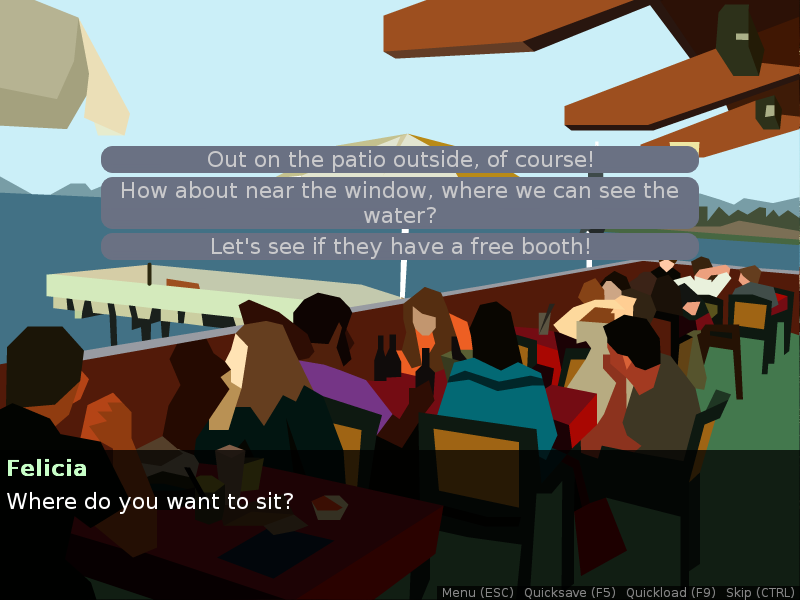
Princess Maker 2 screenshot by Donald Love 87 on GameFAQs

Thursday, May 28, 2015

Does suffering increase hope? Danganronpa 2 thinks so.
Danganronpa 2 is a visual novel murder mystery game where you help solve the crimes. You're one of sixteen high school students stranded on an island, and you can't leave unless you murder another student and avoid detection. If someone can do that, everyone else remaining on the island dies and they can go free. But if you and the group successfully deduce the murderer, the murderer dies and the rest of you can continue to live to play this sick game.

SPOILERS for Danganronpa 2 below.

One underlying theme of the game is that your situation pushes you to a deep despair to allow you to enjoy a greater hope later on. The game presents this hope as vital to your continual survival in a world full of despair. 

Not every religion sees hope as a virtue. Buddhists urge us to abandon hope or "give up all hope":
One of the most powerful teachings of the Buddhist tradition is that as long as you are wishing for things to change, they never will. As long as you're wanting yourself to get better, you won't. As long as you have an orientation toward the future, you can never just relax into what you already have or already are.
In Christianity, hope is a virtue. It's part of having faith to have hope that you will live after death, and assuming that Christianity is correct (that's where the hope comes in), that you will be forgiven of your sins and live eternally. In Danganronpa 2, Chiaki represents the Christian ideal of hope, especially since she saves the group from their deaths through her sacrifice and enables them to return to the world outside the game.

Chiaki represents Christian hope
Christian hope in anime games is all about believing in yourself.
Chiaki is the "regular" flavor of hope, and Nagito represents the diabolical inversion of hope. Nagito is one of your fellow students who seems a little too enthusiastic about the death game. His idea is that by helping to make a completely hopeless or despairing situation, he can actually increase hope when such a situation proves fortuitous.

He attributes this twisted sense of hope to his "ultimate talent," which is that he is ultimately lucky. If he participates in a lottery, he'll win it. If he plays Russian roulette, he'll succeed at not shooting himself.

He orchestrates his death so that the murderer is random. Because he's ultimately lucky, the person he wants to kill him does so unwittingly. If you and your friends hadn't figured it out, he would have ultimately contributed to the deaths of everyone except the murderer. In this way he's also kind of an inverted savior figure, but he is unsuccessful.


In the end, Chiaki does some kind of computer magic, and you're able to break free of the computer simulation and defeat the virus that represents ultimate despair. Why couldn't you go all super-powered earlier?

The way Danganronpa 2 ends, it seems like the authors are rooting for the "ultimate despair leads to ultimate hope" version of things (especially taking the original Danganronpa into account). It certainly makes for interesting, possibly benevolent motives on the part of the characters who set up the death games. 

Certainly in Christianity, there's an idea that everyone goes through "trial by fire," or that the difficulties of life will make you into a more faithful person. But taken to an extreme, this idea is a little disturbing. If hard things in life can make you more faithful or even "better," why not cause other people to suffer so they can reach their ultimate potential? I'd like to think that Christianity has some safeguards against this, like commanding adherents not to murder each other. But what if it was all simulated suffering? Why not incite despair to create hope in a safe environment? Right now my best answer is "because that doesn't seem right, fun, or good" which is pretty unsatisfying. Thanks, Danganronpa 2, for making me think about these things.

Tuesday, May 12, 2015

Four Narrative-Driven Indie Video Games You Should Take Seriously

Games are relaxing and fun, right? Just point and click and let all your worries slip away...

But sometimes it's more satisfying to face those worries head-on, and what better format to do so in than in the safe space of a video game? So, go ahead; ponder the existence and will of God, or the situational ethics of a Battle Royale, or the possibility of being the only survivors of a mass human extinction, or the idea that the most horrifying evil of all dwells in your own heart. Don't worry; it's only a game...

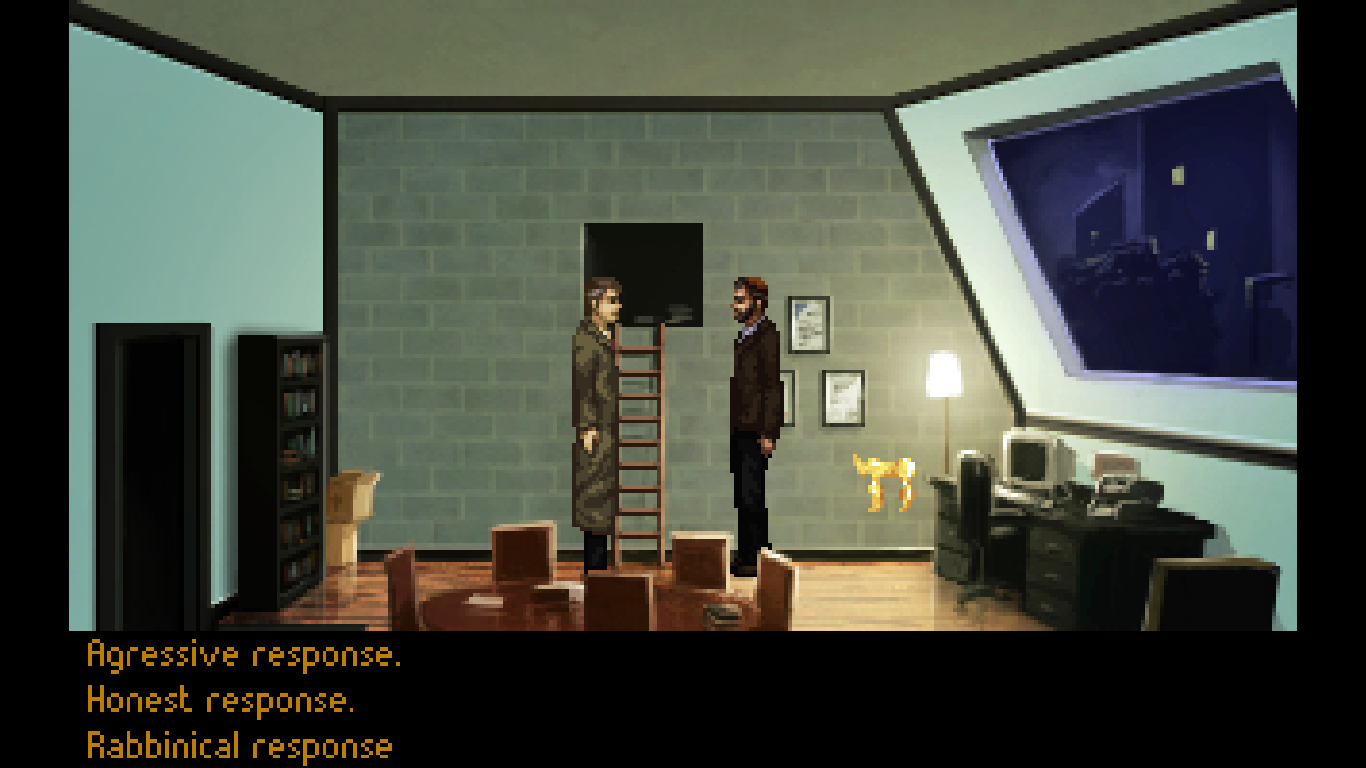
The Shivah by Wadjet Eye Games

(PC/Mac/Linux, iOS, Android; $1.99-4.99)


2015-01-26-231154_1366x768_scrot.png
There’s not really a category for this game - you’re a rabbi investigating a murder in an old-school adventure game format.  Although it is set within the Jewish New York culture, it is still accessible to those not of that culture and its themes are universal. Even as you explore for clues, the dialogue makes you question what it means to be wise, what is God’s will, and what it means to belong to a religious community.  And there’s rabbinical fisticuffs.

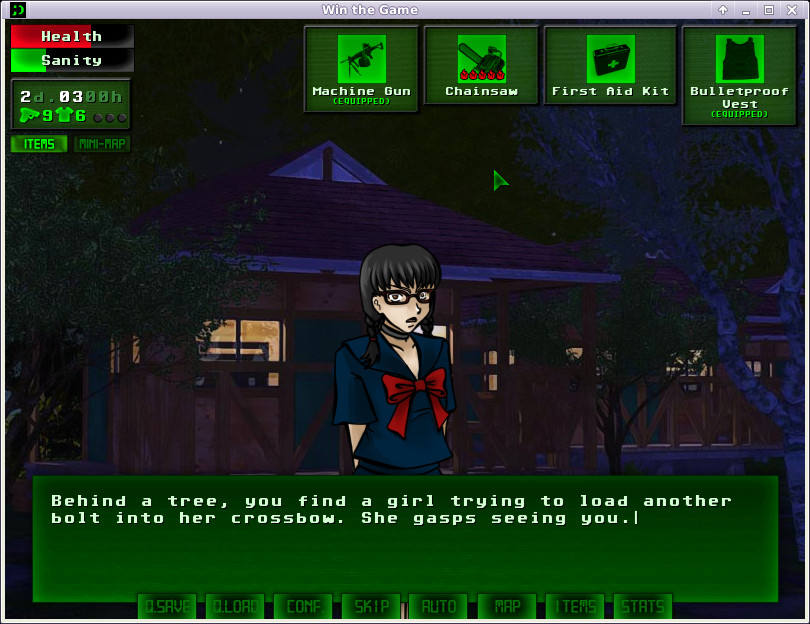
Win The Game by Happy Backwards

(PC, Mac, Linux; free)

screenshot001.jpg
Actually being inside a fight-for-your-life game like the Hunger Games would be awful, no doubt about it. But, it turns out playing this game about that kind of survival scenario is not only strategic and adrenaline-pumping, but it’s also thought-provoking, morbid, and… fun?  Maybe it shouldn’t be fun. But it is!

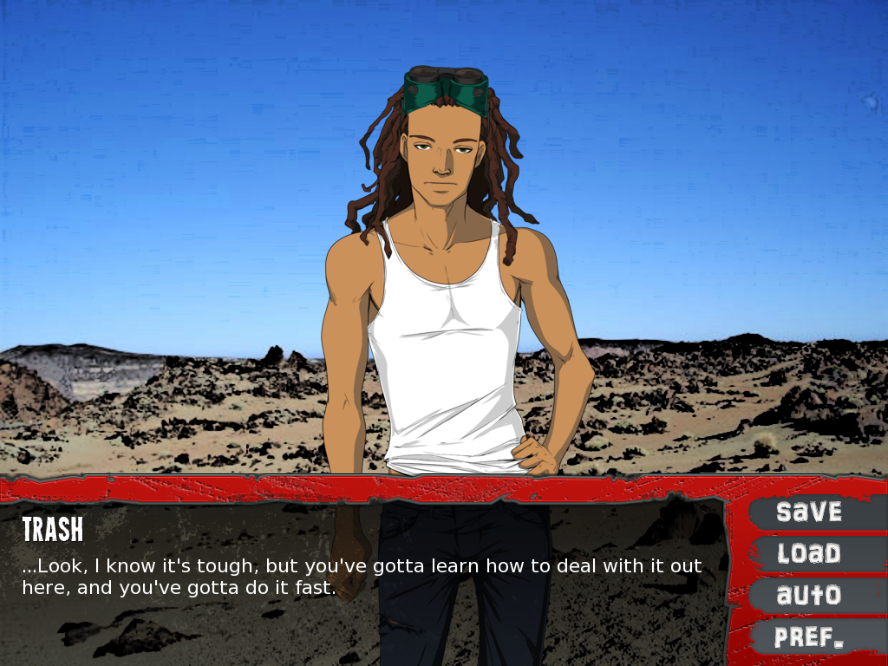
Aloners by Sonnet009

(PC, Mac, Linux; free)
screenshot0001.png
Post-apocalyptic romance is a saturated genre right now-- but this gem stands out above the rest for its flexible main character choices, characterization, and backstory.  While a lot of items in this genre suffer from too much romance or too much action, this visual novel gets the balance just right, with intricate character building and relationship exploration interspersed with wasteland scavenging and life-threatening situations.

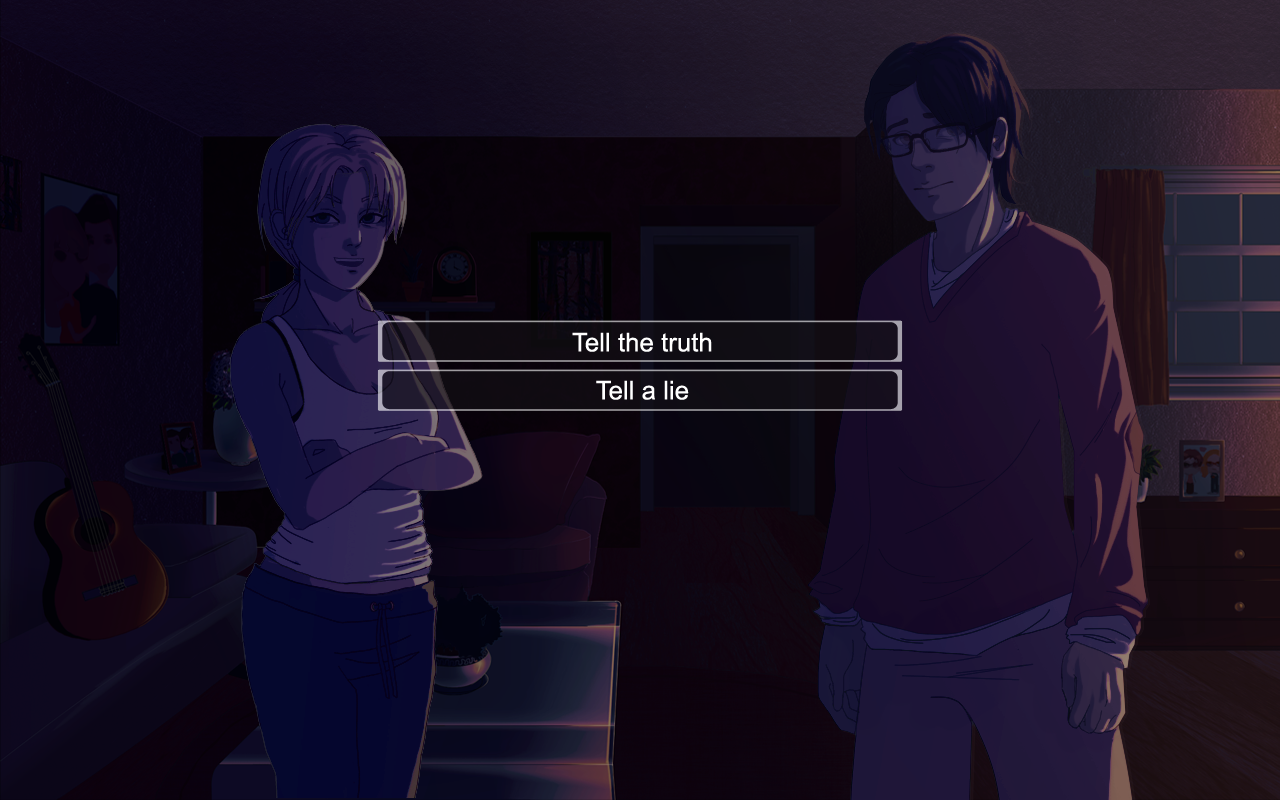
Who Is Mike? by FERVENT

 (PC, Mac, Linux; free)

W%2B%2FDQA.png

This psychological horror visual novel starts with you waking up in the same room as an identical doppleganger.  One of you has to be real.  Could you both be real? Or maybe one of you is trying to take over the real person's life. It has you wondering who the real enemy is, and seriously causes you to pause and consider if it might actually be YOU.  Don't stop until you've seen all the endings to make sure you see all of this clever story full of twists.

Monday, May 4, 2015

These sexy characters don't really want to be with you

My sister Andrea mentioned Taarradhin in a round-up post last October, and I finally got around to playing it. It's short, but it caused me to reflect on the role of romantic interests in dating games. Spoilers for the game follow.

On your first playthough of Taarradhin, you can choose to romance either one of two new slaves in your palace or simply get to know them both a little. The mechanic for choosing has a satisfying logic; if you choose to talk to one of them twice in a row, you're romancing them. In the end, it turns out the slaves were meant to be as a sacrifice to the goddess to petition for rain. You can save the one you romance but there's a feeling of incompleteness. Since the two romance-able characters are slaves, you get the feeling that they're slightly distant from you and trying to please you, even after a "happy" ending with them.

Often in dating games, each new character provides an exciting opportunity to woo and "win over." But the "true ending" in Taarradhin doesn't have you marrying anyone. The "true ending" only unlocks after you've seen the other endings, as if you, the player, needed to get your selfish romancing desires out of the way before you could start to care about the characters on a deeper level.


It's only in the final ending that your player-character really gets to know the two strangers and starts to change her own ideas about the world, shedding some of her entitlement and ignorance (but still retaining her youthful charm). She feels enough compassion to offer herself as a sacrifice in place of her slaves, and subsequently free them. It's much more satisfying than the romantic endings. Because while being married to royalty sounds like a nice life, it would be even nicer to choose one's own path.


I feel like this game caught me objectifying their characters and then gently reminded me that even handsome and beautiful people have their own hardships. Sure, if I'd had the option to talk to them more in the first playthrough, I would have done it then. But because of how the developers unveiled the information, it made me reflect on how I'm sometimes like Neqtia, blissfully unaware in my own little world and just seeing others as a means to achieve my own goals.

Friday, April 24, 2015

How the Internet liked Our Personal Space

It's been two and a half months since we launched Our Personal Space and it has been a great success! We've had over 3,000 downloads so far. We've received reviews from videogame websites, mentions on tumblr, and someone even did a let's play. It's possible you're sick of hearing me sing praises of our praises, and if so consider this post "for the record."

Probably our biggest coverage came from Rock, Paper, Shotgun's Freeware Garden feature. Konstantinos Dimopoulos enjoyed the game:
It’s up to you and the choices you make to help this wonderful game tell a tale of hope. A tale of cooperation, peaceful, interesting lives, democracy, love and community in a science fiction setting that masterfully blends future technologies with historical frontier sensibilities; thankfully this time without the brutal slaughter of indigenous peoples.
After the article went up our server went down and I spent the morning chatting with my sister about how to fix things. I found out that I didn't have the most recent installer anywhere! That's what I get for using git. Notes for next time: have a mirror link ready!

 Kimberly at JayIsGames also reviewed the game:
The cast of characters are well drawn and their interactions and the sense of community feel real. While the sci-fi aspect of the game is wonderful, Our Personal Space is not just about physical survival, but ultimately about relationship survival.
On tumblr, the Utah Games Guild, and Fuck Yeah Ren'Py blurbed the game (I actually submitted the post for the Ren'Py tumblr). Gwen at Welcome to Otome Hell wrote a lovely review:
This is a game that allows you to create a character that reacts in the same way you would yourself, and shows legitimate consequences for your actions. Do you want to leave your husband? You can. Do you want to be a loving and devoted wife? You can. Do you want to dedicate yourself to your work and make the colony succeed? You can. Do you want to laze around, learning and doing as little of importance as possible and causing the colony to suffer in consequence? Guess what: you can. I honestly cannot communicate how in love I am with this game. Play it.
Andrea got the game on the Google Play store and we had some very positive reviews there as well. My favorite is from Ace Penguin:
It teaches me to trust people and forgive them . This game makes me feel warm and happy. I wish there are more games like this!
Additionally, SuperPaulGames has done a complete Let's Play on youtube! His commentary is very crass, with lots of sex jokes and fart-type jokes. I didn't watch all of it, but I found it simultaneously annoying and entertaining.

We're grateful to everyone who has played the game and especially those who have said nice things about it. We're planning to submit our game to Indiecade!

Saturday, February 14, 2015

Our Personal Space is live!

I'm happy to announce that Our Personal Space is now live! Download it here for Windows, Mac, Linux, or Android. We're giving it away for free!

My sister Andrea and I started on this game when we realized we wanted to see more games that explored a married relationship, and my sister-in-law Clarissa did all the character art. I had been playing around with Ren'Py a little, and it was a great way to get something working right away. 


I'm always hesitant to experiment with coding. It's one difference I've noticed between me and experienced coders like my sister and my husband--I'm always worried I'll mess stuff up, but they're quick to experiment and see how everything works. My "coding" was limited to things like changing variables and "if-then"-type clauses. But I did feel pretty cool when something I wrote worked!


Our Personal Space is like a dating sim in that you have a romantic relationship with a fictional character. But you're married, so it's more about the little choices you make from day-to-day than the excitement of "will we kiss?" at the end of a date. Like in real long-term-relationship, you have other things you're worried about too, like how stressed you are and, in this case, if your colony on another planet will survive. When I look back on the games with dating elements I've enjoyed, many of them have other elements to worry about. Since Persona 4 is part time-management game, when you choose to spend time with someone, it feels more like you're indicating you like them somehow (although if you're playing strategically, wanting to level up a relationship has other motivations). Each month in Our Personal Space you can choose to spend time alone, which decreases your stress more, or spend time with your husband, which increases your relationship (but doesn't decrease stress as much). 

One part of Our Personal Space that we might have gone a little overboard on is on choices. The above screenshot is from a New Game+, and the options in italics are only available if you have a certain skill at a certain level. So, on a first playthrough, you might only see one of these options in italics. We wanted to make the game fun to replay, not just to get different endings, but also to see what other options are available (like if you choose to have a baby or not). It's kind of a slow build-up, but I think it's pretty fun! Please try it out, and if you do, I'd love to hear what you thought of the experience--good and bad! There's some discussion going on over on the Lemmasoft forum. Here's the trailer:


Note: Content-wise, I think this game would have a T rating. There are some parts where it's heavily implied that you and your husband are having sex, but it's not explicit. If you were reading it I'd call it a "clean" romance. So feel free to let your teenager play!

Wednesday, October 29, 2014

October BoRT: A playtesting mask

This month's BoRT is about masks in games. I usually play choice-driven games very sincerely, so I don't feel like I'm wearing a mask when I play them. Obviously, I'm not a Japanese high school student or whoever the player-character is, but I usually choose options that make sense to me.

In his Designing Virtual Worlds, Richard Bartle discusses why players play in virtual worlds. He says things like "virtual worlds enable you to find out who you are by letting you be who you want to be." But he's clearly against the mask metaphor--if you become the character you're playing (your "mask"), then you're not really role-playing anymore, are you? For Bartle, role-playing is a kind of psychologically helpful exercise in acting. He's passionate that playing a character completely different from yourself is freeing. It inspired me to create a guardian character in Guild Wars 2 (since I usually play magic-users). But I found that simply playing a different character class didn't make me feel any different about how I played. For me, it took role-playing as a different kind of player (a playtester) to change how I played my characters.

My sister and I have been working on a marriage-relationship-sim game called Personal Space, and lately I have been doing a little playtesting. As a playtester, I want to try different play styles. Instead of choosing what I know will "win," I start role-playing different kinds of players.
no, I don't want to help you right now
My last playthrough, I maxed out my spiritual stat, but I chose somewhat impulsive or selfish replies when interacting husband character. I was studying spiritual writings every week, but there was nothing forcing me to actually change my character's personality. It's a simulation, so there's some limitations to what your character can do, but I felt like maybe I was more like this "impulsive" character than I'd like to be. I study my religion's teachings and I have aspirations at being a more "spiritual" or loving person, but on the other hand, sometimes I'm kind of an impulsive jerk. I'm sure it's possible to role-play a hypocrite in other games, but I hadn't really tried it until I felt like I had to explore different options as a playtester.

I don't think that catharsis or "venting" is helpful for controlling my emotions. But I do think that exploring my options in a videogame is a safe way to see that my habitual way of interacting with others isn't the only way (kind of an odd thing to discover while playing a game I helped write, but there you have it).

Sunday, October 26, 2014

Love and Dating Visual Novels

And now, just in time for Halloween, it’s…


Love and Dating games!  What could be more frightening than admitting a possibly unrequited love, or taking that first leap to a deeper relationship, or staying with just one person for the rest of your life?!  Time to face your fears with these visual novels about love and dating!

All of these below are available for free for Windows, Mac, and Linux.

Save the Date

screenshot0001.png
Have you ever felt like dating was a game that it was impossible to win? Like all the cards were stacked against you?  Things quickly devolve into the improbable and surreal as you try to overcome impossible odds and save your date in this love sim parody.  

That Cheap and Sacred Thing

TCASTscreenshot03.png
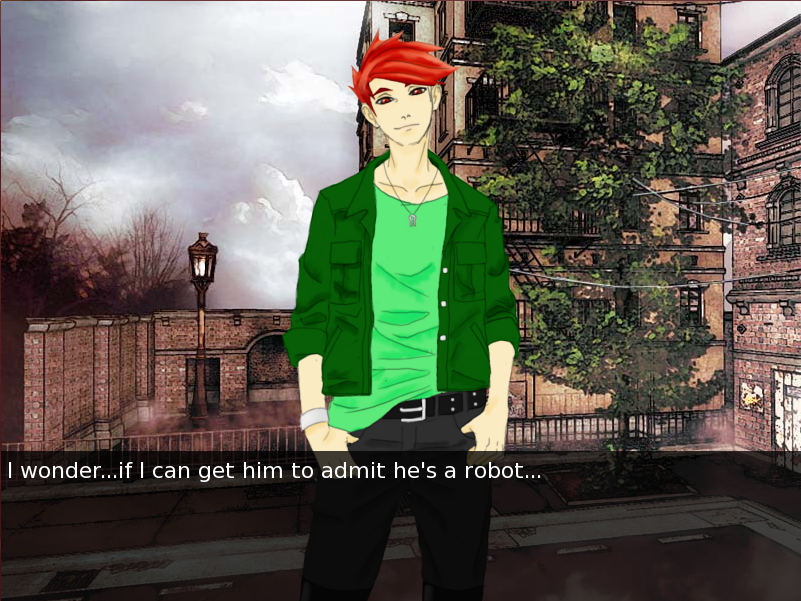
If an android could love - true love - how would it manifest?  What kind of a relationship can an android and a human really have, when both are so limited?  Explore these questions in this kinetic novel.

Wedding Vows

wedding-vows.png
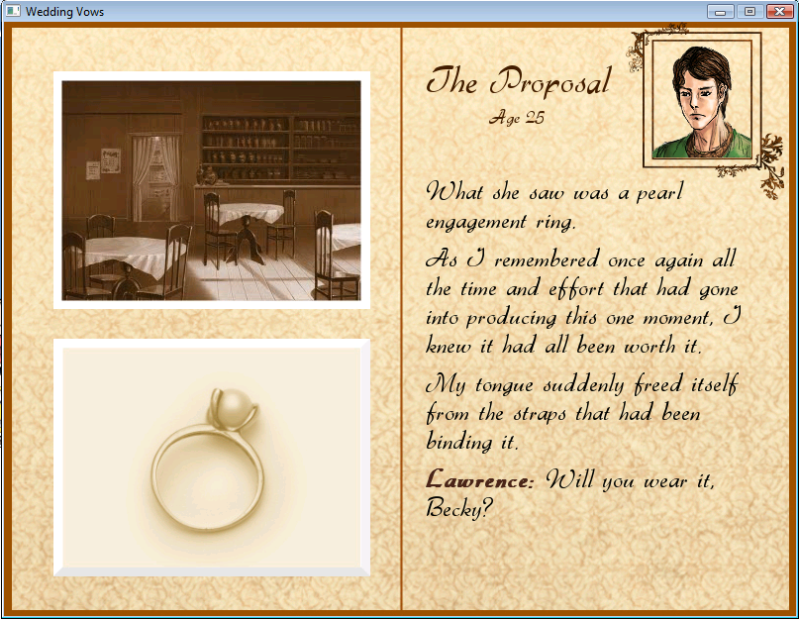
Not only does this kinetic novel follow a couple over the course of decades, but it does so in a sweet and non-linear fashion, showing both the influence of the past and its impermanence.  

Taarradhin

screenshot0005.png
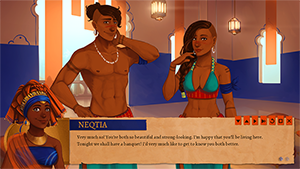
With a beautiful, ancient Egypt-inspired setting and gorgeous character art and backgrounds, this visual novel examines slavery, romantic and non-romantic love, and our perceptions of our own culture and other people. Make sure you get all the endings and then the true ending!

Wednesday, July 23, 2014

Ace Attorney's resourcefulness as an advantage

The Ace Attorney series of games lets you play as a lawyer/detective to investigate and solve mysteries, usually murders. The series is well known for its over-the-top characters and ridiculous dramatic twists.

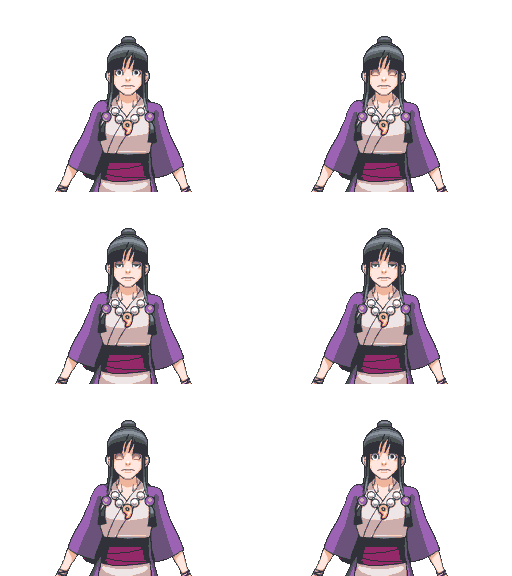
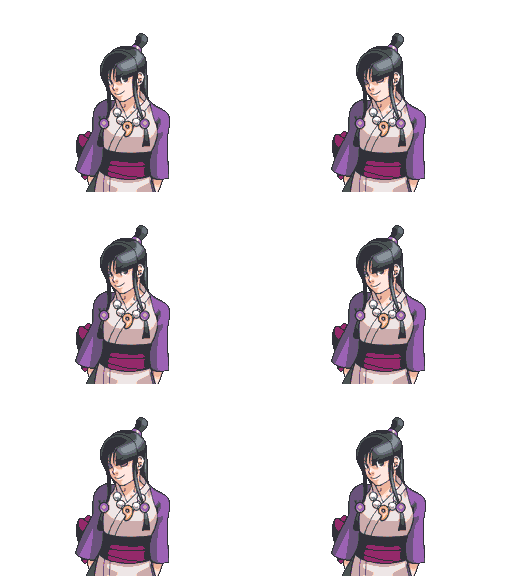
I recently finished playing the first three Ace Attorney games, and I was impressed with how much they did with what seemed like not very many art assets. The first Ace Attorney episode has 11 characters, only 3 of which are exclusive to that episode. Pheonix Wright himself has about 10 different poses (with variants in how his mouth moves and whether or not he's moving). Most characters you talk to/cross-examine have around 6 different poses. I guess looking at it now, that does seem like a lot of art, especially if one person had to make it all, but it's not an impossible amount. But for a whole team of artists, that's totally doable! The different poses really show the character's personality too. The bizarre personalities and artwork are half the fun!

I found it interesting how the different poses could be combined to create different impressions. While a character might only have 6 poses, different combinations (surprised/worried, confident/thinking) make it feel not as limited. And usually, the character has one or two poses they only use rarely, which also helps give an impression that they have a wide variety (i.e., you don't see a character's whole spectrum of poses in just one conversation). The pose animations are usually super simple too, like one arm moving back and forth. The paucity of poses actually make the characters stronger because they have a few readily recognizable poses, which are carefully tailored to reflect their personality. This contrasts a lot of 3D art where half the characters have the same body and gait. With 2D art it is easier to make a variety of body types, tics, postures, and mannerisms.

Tuesday, April 29, 2014

Grace's Diary as educational media

I recently played the very short visual novel game Grace's Diary (play it here, more info here). It looks and feels a bit like Hotel Dusk, except it was made for a contest to educate players about teen violence without using violence in the game. You're a teenager concerned about your friend, and you look around your room to remember things about your friend that will convince her that she's actually in an abusive relationship. For some reason when main character is remembering these things that made her uncomfortable it feels natural and not like "here are the signs of an abusive boyfriend!" It's also somewhat difficult to get your friend to leave her abuser.

Seeing how natural it felt to have relationship education in a visual novel made me wonder what other types of knowledge visual novels might be well-suited to teach. With their emphasis on dialog (and choices), I think it would be fairly easy to make educational games about other types of relationships--like how to interact with screaming children, how to assert yourself in a conflict, and how to make a polite request. Of course, writing that type of game assumes you know what the best thing to say is, which can vary a lot depending on the situation.

N.B. It looks like the same developer, Hima, made another really similar game another year for the contest called Janie's Sketchbook. This time the protagonist had some bad relationship habits!

Sunday, March 23, 2014

Indier than Thou (Visual Novel Review)

It's pretty cool to be an indie game developer these days. But while some have seen great commercial success, there are plenty of great indie games that people haven't played simply because they don't know about them. Some may also think that if a game is free, it must not be any good.


This is even more true for visual novels. Visual novels still seem to be in a somewhat awkward niche between “real computer games” and choose-your-own-adventure novels.  That is unfortunate, because these are some of the best interactive fiction I’ve read lately, with powerful twists and realistic characters and a lot of emotional impact.  Since they are available for free for Windows, Mac, and Linux, you really have no excuse not to at least give them a try!


SOON

soon-screen_zpsbd8de97a.jpg

Time-travelling, mad science, and killer robots are great and all, but they are not enough to make a good story.  But SOON is not just a romp through time and space - it also has funny, realistic characters we care about, who make tough choices and change over time. Your sympathies and goals will change as you change time in this choose-your-own-adventure visual novel reminiscent of Jason Shiga’s Meanwhile.


The Dreaming

screenshot0001.png

Don’t be deceived by the simplistic anime art style - this is psychological horror of the best kind. While movies can sometimes make you feel some of the things the main character feels, games and visual novels are a much better medium for really experiencing complex emotional questions such as “Is this real?”, "How can I help someone who seems delusional?" and “Would I know it if I was insane?”.


Romance is Dead

screenshot0001.png

This quirky supernatural romantic tragicomedy’s greatest strength is its characters. The main character’s witty dialogue and intelligence are a refreshing contrast to the angsty indecisiveness so often found in the romance genre. It’s definitely worth replaying several times to uncover each character’s secrets, past, and true motivations. The jazzy music lends a distinctively New Orleans flavor to the game as well.


Adrift

screenshot0001.png

In Adrift, you are the human in charge of an underwater city, but your body is locked away in a stasis chamber. You must get both robots and humans to be your eyes, ears, and hands in this game that will test your perception, management skills, and creativity.

Monday, August 19, 2013

Android's best visual novels

It's hard to find good visual novels for Android. I know, because I've played some awful ones. Thankfully, my sister Andrea has picked out three of her favorites in another guest post:

Visual Novels for Android

Combining the prose of a novella with the decision-making of a game, these are some of the best visual novels I’ve played recently:

Days of the Divine

Set in an ancient Asian-fantasy setting, ancient gods waken and you mediate their conflicts as a shrine maiden. Three vastly different endings, plot twists, and solid characters are accompanied by beautiful art and soundtrack. Available for Win, Mac, Linux, Android.

Nanolife

From the same developers, but with a completely different tone and theme, this visual novel has you take the part of an MMO character who thinks the game world is real. Funny and sweet.  Available for Win, Mac, Linux, Android.

a2 ~a due~ 


Polished, poignant visual novel about a young woman who’s forced to manage her father’s orchestra, with themes of overcoming language barriers and parental expectations. Available for Win, Mac, Linux, Android.

Monday, February 25, 2013

Virtue's Last Reward fixes all the annoying things about 999

Remember when I was whining that visual novels should learn a thing or two from sequential art/comics? I think a designer over at Chunsoft must have felt the same way, because Virtue's Last Reward (VLR) solved most of the problems I had with 999. VLR is the sequel to 999 and is in the same genre: visual novel with periodic escape puzzles.

The worst thing about the writing in 999 was that it was redundant to visual information. It was like they were expecting a blind person to play the game and describing physical attributes and degree of passion on comments when we had a picture of the person and their expression to learn that from. Thankfully, VLR cut back on this annoying literary technique. It made the dialogue go by faster and helped it feel like a game where characters are talking to each other and not a novel being read to you.

By far my favorite part of VLR, which I think other branching stories should adopt, was the story flow chart.
After you get one ending, instead of starting from the beginning and skipping through lots of text, you can go back to the last story-branching decision and choose the other option. Or you can go to some other branch and see how that part unfolds. You still end up skipping a lot of text, but compared to the alternative it is relatively painless.

The other nice part is that after you escape from a room once, you don't need to ever solve it again to escape. This feature isn't used very often though, because the designers made it so every single path has a different puzzle room to solve. So the writing is better and the branching story is easier to navigate.

Another aspect I liked was that the things you learn in some branches of the storyline unlock other parts. It made it feel more like you were building up to the "true" ending and less like you were just seeing all the possible endings. The fact that your character can sometimes remember things from other timelines makes this like... a modernist visual novel? Or you know, just ridiculous sci-fi. There are so many crazy reveals and it made me look forward to each ending. I can't believe I actually LIKED the ridiculousness of it all. I'm looking forward to the sequel.

Thursday, August 30, 2012

Ghost Trick expertly uses elements of visual novels.

Whenever I have a hard time thinking of what I should write for a blog post, I try to think of a game I have played and not written about. Usually I'm like "ahhh I had things I wanted to say while I was playing this and forgot all about them!" So my advice to myself is: if you play a game, write about it. I've been trying to cover some more obscure things over at Kill Screen (maybe to a fault). And it's kind of hard to find stuff sometimes! I spend a lot of time curating--reading over news from various sites and mulling over whether or not our readers would find it interesting. I should probably get less picky because it's ridiculous how much time it can take (or not take).

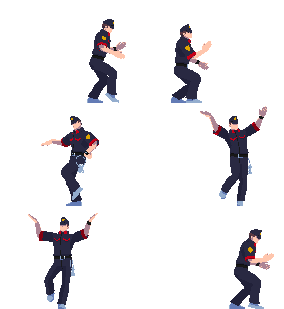
ANYWAY, what I really wanted to write about is how Ghost Trick basically addressed all my complaints in my post about what visual novels should learn from comics. Short recap: Things that bug the heck out of me in visual novels are 1) information redundant to the artwork, 2) artwork that doesn't pack much information in it, and 3) a slow pace. Ghost Trick avoided all of these. The narration didn't tell me things I already knew from visual information (though it did review information I needed to make sense of the plot). Characters had unique animations that brought out their personalities:


The game ended about where I was beginning to tire of the mechanics, and had a satisfying, if ridiculous, ending. It was really fun to see a game execute parts of visual novel style in such an excellent way. Some might argue that it's not really a visual novel, in which case I might just have to admit that I don't particularly like visual novels as a genre.

I feel bad about disliking most visual novels... but I think if I'm going to spend all that time reading on a bright screen I want to have some interaction with the story. If there isn't some kind of gameplay (like the puzzle sections in Ghost Trick or 999), or a branching storyline, then I might as well be reading a comic book, in my mind.

I started playing around with Ren'Py, the python-based visual novel engine, and immediately I wanted to learn about things like making choices and keeping track of statistics. I think it's more about how the elements of visual novels combine with others that make it interesting (I find reading scripts for plays terribly boring, but generally enjoy seeing them... I see visual novels as a game that's missing vital parts). On the other hand, I can see how for a budding designer, learning one or two parts of a game at a time could be really useful, fun, and instructive. Feel free to share about why I shouldn't give up on visual novels!

Thursday, February 16, 2012

Dear Esther's setting matches its emotional push

The most memorable part of Dear Esther is its setting: an island off the coast of the UK containing a cave and some abandoned buildings. Walking through it felt a little like watching LOST--hope for some awesome, supernatural explanation, and disappointment with an ending that brought up more questions than it answered. And like LOST, the setting is a mysterious island often described in metaphorical terms. 

In my Western-American literature class, we often discussed the importance of the western setting. Wide open plains and awe-inspiring mountains evoke a fear and respect for nature, and feelings of freedom but also oppression (it's contradictory. It's literature). The island and cave had a different significance. The narrator explored his own feelings about being on the island and towards Esther, and such introspection seems even more fitting inside the earth. Climbing up the island and the final descent accompanied the rising realizations and letting go. The focal point of this game at every moment is the place, places which evoke memories and hasten death. 


At the same time, it's not just an island. It's hyperreal; it is more beautiful than real nature. And, like the setting, the story is better in my imagination than it is in the script. When I actually looked at the script, the story lost its mystery. It became an impressionistic, surreal kind of rambling, whose allusions shed little light on the actual events leading up to the narrator's arrival on the island. But at the same time, the experience of the game/hypertext was highly evocative of loneliness, loss, and confusion. The island is not a place in the physical world, it is a digital medium to evoke the bittersweetness of cold beauty that is completely unsentient, matched by memories of a loved and dead person. In this way, I believe Dear Esther succeeds in connecting its setting to its story. 

And, this is completely changing the subject, but if you're curious about how to classify games in the literary scheme of thigns, Aarseth has an interesting system:
Aarseth's ergodic literature chart, which you can read more about here
Some people have noticed that Dear Esther isn't really a game, or what game there is is purely evocative. The above chart comes from Aarseth's book Cybertext: Perspectives on ergodic literature. A branching path (even if it's not branching for very long) qualifies as explorative; if the text's appearance is in part chosen or created by the user, it is configurative, and permanent user additions make it textonic. 

The interesting thing to me is that, because of its randomized sections, Dear Esther is a configurative cybertext--less pre-determined than other games like Portal. The difference is that with Dear Esther, there is no puzzle or non-story part besides walking. Also, I don't really think the randomization of text improves my experience with Dear Esther. It seems like a gimmick to make me re-visit the game, which I will probably do anyway next time I miss seeing the ocean.

Wednesday, February 15, 2012

What visual novels should learn from sequential art

Recently I've played a few visual novels, or games with visual novel elements (999: Nine Hours, Nine Persons, Nine Doors, Katawa Shoujo, Re Alistair++, and Trace Memory). I understand the focus on story and having lots of text is from the visual novel tradition. I just don't understand why it isn't better.

I think visual novels qualify as sequential art, and should start acting like it. Here's some things visual novels need to work on (I had ambitious visions of side-by-side manga and visual novel screenshots, but please do some imagining in your head):

-Visual and textual information should be complimentary, not redundant. 999 drove me crazy when a character would appear on-screen looking surprised, and the text itself would tell me this character was speaking and felt surprised. We're familiar with the convention that the person on screen is talking, or if there are multiple people on screen that their speech bubbles have their name on them. Even picture books can get this right--little tidbits of additional information should be contained in the accompanying illustrations.
can we please just show all the refinement and dignity in the artwork?
-Replace redundant visual information with relevant. Most visual novels are pretty good with showing people in a flashback. But how about more closeups of salient details (people were always eating in Katawa Shoujo and I almost never got to see the food)? I also like seeing what character I'm playing and how they react to conversations (Touch Detective uses the entire top screen for this, and it is darling). I like it when my character has his own ideas about choices I make, though granted many visual novels have limited options. I don't like seeing the same artwork over and over.
maybe a whole screen is a little much to dedicate to your character's reactions... but it's soo cute!
-Pace text faster than a novel. I know it's called a visual novel, but if I'm going to the trouble of reading on a bright screen, I want a polished, fast-moving story. Conversations and plot/action should alternate--my least favorite comic books are the ones with talking heads (and sometimes just one head, for those inner monologues that seem to be endless). Trace Memory did an excellent job of steadily revealing more and more information about the game's mysteries and alternating with action--a puzzle, or discovery of a person or secret passage (the best part was when a puzzle revealed something about the plot). If you don't read manga, think of Calvin & Hobbes--even if the entire comic strip is just a dialogue, at least they're sledding down a gigantic hill.

-Use animations resourcefully. If we classify animation as many static images linked together, it can still technically qualify as sequential art, and I think that qualification makes sense in the context of visual novels, which sometimes include small animations like head nods and toe-tapping. Animations in a character, when reused in the same contexts, make mannerisms. Mannerisms can be part of an interesting and dynamic character.

I know that many of my complaints are because of budget/time constraints on visual novels. But not all of them are! I like the idea of the visual novel and I think it is a genre that is a little neglected. It's possible that I should give up on visual novels and concentrate on finding a really good simulation game--do we have a modern Princess Maker 2, and is it something other than The Sims? I like my simulation games to have some story to them (edit: maybe Cherry Tree High Comedy has what I'm looking for? I'm stoked!)!

Let me know in the comments if you agree that visual novels need to reformed, or if I'm completely misunderstanding the genre! I love having conversations about this kind of stuff.