Showing posts with label defining games. Show all posts

Thursday, August 30, 2012

Ghost Trick expertly uses elements of visual novels.

Whenever I have a hard time thinking of what I should write for a blog post, I try to think of a game I have played and not written about. Usually I'm like "ahhh I had things I wanted to say while I was playing this and forgot all about them!" So my advice to myself is: if you play a game, write about it. I've been trying to cover some more obscure things over at Kill Screen (maybe to a fault). And it's kind of hard to find stuff sometimes! I spend a lot of time curating--reading over news from various sites and mulling over whether or not our readers would find it interesting. I should probably get less picky because it's ridiculous how much time it can take (or not take).

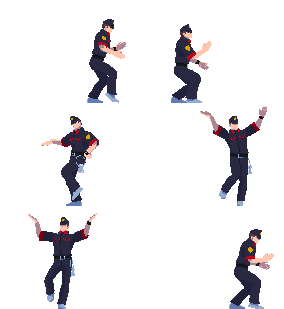
ANYWAY, what I really wanted to write about is how Ghost Trick basically addressed all my complaints in my post about what visual novels should learn from comics. Short recap: Things that bug the heck out of me in visual novels are 1) information redundant to the artwork, 2) artwork that doesn't pack much information in it, and 3) a slow pace. Ghost Trick avoided all of these. The narration didn't tell me things I already knew from visual information (though it did review information I needed to make sense of the plot). Characters had unique animations that brought out their personalities:


The game ended about where I was beginning to tire of the mechanics, and had a satisfying, if ridiculous, ending. It was really fun to see a game execute parts of visual novel style in such an excellent way. Some might argue that it's not really a visual novel, in which case I might just have to admit that I don't particularly like visual novels as a genre.

I feel bad about disliking most visual novels... but I think if I'm going to spend all that time reading on a bright screen I want to have some interaction with the story. If there isn't some kind of gameplay (like the puzzle sections in Ghost Trick or 999), or a branching storyline, then I might as well be reading a comic book, in my mind.

I started playing around with Ren'Py, the python-based visual novel engine, and immediately I wanted to learn about things like making choices and keeping track of statistics. I think it's more about how the elements of visual novels combine with others that make it interesting (I find reading scripts for plays terribly boring, but generally enjoy seeing them... I see visual novels as a game that's missing vital parts). On the other hand, I can see how for a budding designer, learning one or two parts of a game at a time could be really useful, fun, and instructive. Feel free to share about why I shouldn't give up on visual novels!

Thursday, February 16, 2012

Dear Esther's setting matches its emotional push

The most memorable part of Dear Esther is its setting: an island off the coast of the UK containing a cave and some abandoned buildings. Walking through it felt a little like watching LOST--hope for some awesome, supernatural explanation, and disappointment with an ending that brought up more questions than it answered. And like LOST, the setting is a mysterious island often described in metaphorical terms. 

In my Western-American literature class, we often discussed the importance of the western setting. Wide open plains and awe-inspiring mountains evoke a fear and respect for nature, and feelings of freedom but also oppression (it's contradictory. It's literature). The island and cave had a different significance. The narrator explored his own feelings about being on the island and towards Esther, and such introspection seems even more fitting inside the earth. Climbing up the island and the final descent accompanied the rising realizations and letting go. The focal point of this game at every moment is the place, places which evoke memories and hasten death. 


At the same time, it's not just an island. It's hyperreal; it is more beautiful than real nature. And, like the setting, the story is better in my imagination than it is in the script. When I actually looked at the script, the story lost its mystery. It became an impressionistic, surreal kind of rambling, whose allusions shed little light on the actual events leading up to the narrator's arrival on the island. But at the same time, the experience of the game/hypertext was highly evocative of loneliness, loss, and confusion. The island is not a place in the physical world, it is a digital medium to evoke the bittersweetness of cold beauty that is completely unsentient, matched by memories of a loved and dead person. In this way, I believe Dear Esther succeeds in connecting its setting to its story. 

And, this is completely changing the subject, but if you're curious about how to classify games in the literary scheme of thigns, Aarseth has an interesting system:
Aarseth's ergodic literature chart, which you can read more about here
Some people have noticed that Dear Esther isn't really a game, or what game there is is purely evocative. The above chart comes from Aarseth's book Cybertext: Perspectives on ergodic literature. A branching path (even if it's not branching for very long) qualifies as explorative; if the text's appearance is in part chosen or created by the user, it is configurative, and permanent user additions make it textonic. 

The interesting thing to me is that, because of its randomized sections, Dear Esther is a configurative cybertext--less pre-determined than other games like Portal. The difference is that with Dear Esther, there is no puzzle or non-story part besides walking. Also, I don't really think the randomization of text improves my experience with Dear Esther. It seems like a gimmick to make me re-visit the game, which I will probably do anyway next time I miss seeing the ocean.

Wednesday, February 15, 2012

What visual novels should learn from sequential art

Recently I've played a few visual novels, or games with visual novel elements (999: Nine Hours, Nine Persons, Nine Doors, Katawa Shoujo, Re Alistair++, and Trace Memory). I understand the focus on story and having lots of text is from the visual novel tradition. I just don't understand why it isn't better.

I think visual novels qualify as sequential art, and should start acting like it. Here's some things visual novels need to work on (I had ambitious visions of side-by-side manga and visual novel screenshots, but please do some imagining in your head):

-Visual and textual information should be complimentary, not redundant. 999 drove me crazy when a character would appear on-screen looking surprised, and the text itself would tell me this character was speaking and felt surprised. We're familiar with the convention that the person on screen is talking, or if there are multiple people on screen that their speech bubbles have their name on them. Even picture books can get this right--little tidbits of additional information should be contained in the accompanying illustrations.
can we please just show all the refinement and dignity in the artwork?
-Replace redundant visual information with relevant. Most visual novels are pretty good with showing people in a flashback. But how about more closeups of salient details (people were always eating in Katawa Shoujo and I almost never got to see the food)? I also like seeing what character I'm playing and how they react to conversations (Touch Detective uses the entire top screen for this, and it is darling). I like it when my character has his own ideas about choices I make, though granted many visual novels have limited options. I don't like seeing the same artwork over and over.
maybe a whole screen is a little much to dedicate to your character's reactions... but it's soo cute!
-Pace text faster than a novel. I know it's called a visual novel, but if I'm going to the trouble of reading on a bright screen, I want a polished, fast-moving story. Conversations and plot/action should alternate--my least favorite comic books are the ones with talking heads (and sometimes just one head, for those inner monologues that seem to be endless). Trace Memory did an excellent job of steadily revealing more and more information about the game's mysteries and alternating with action--a puzzle, or discovery of a person or secret passage (the best part was when a puzzle revealed something about the plot). If you don't read manga, think of Calvin & Hobbes--even if the entire comic strip is just a dialogue, at least they're sledding down a gigantic hill.

-Use animations resourcefully. If we classify animation as many static images linked together, it can still technically qualify as sequential art, and I think that qualification makes sense in the context of visual novels, which sometimes include small animations like head nods and toe-tapping. Animations in a character, when reused in the same contexts, make mannerisms. Mannerisms can be part of an interesting and dynamic character.

I know that many of my complaints are because of budget/time constraints on visual novels. But not all of them are! I like the idea of the visual novel and I think it is a genre that is a little neglected. It's possible that I should give up on visual novels and concentrate on finding a really good simulation game--do we have a modern Princess Maker 2, and is it something other than The Sims? I like my simulation games to have some story to them (edit: maybe Cherry Tree High Comedy has what I'm looking for? I'm stoked!)!

Let me know in the comments if you agree that visual novels need to reformed, or if I'm completely misunderstanding the genre! I love having conversations about this kind of stuff.


Friday, September 23, 2011

Interactive Ritual

I've been thinking about video games and their growth from other interactive mediums. Perhaps spurred by Alternative Ending's apology for RPGs and desire for more emergent narrative, although I'm not yet sure how much this discussion will have to do with her discussion.

Interaction has been and still is a part of human rituals. So far I have categorized these interactive rituals into three categories, defining a ritual as an action that is performed multiple times in the same way, usually with pre-scripted parts, and interactive where the participant does something. I feel like there should be another classification for where the participant can do multiple things which in turn affect the outcome of the ritual, but I don't know what that word is yet:

Social rituals (require more than one person):
-Oaths. The marriage oath, swearing into court, and the presidential inauguration all require the participant to accept or reject the situation, with different consequences either way. 
I really just wanted an excuse to put in a picture of a Russian orthodox church.
-Call-and-Response.  Common in camp songs and some Christian-type sermons. The leader says one part, and the audience answers theirs or repeat what has just been said. 
-Call-and-Action. Traditional storytelling that has the audience do actions in certain parts would fall here, as well as children's finger plays. Singing with actions, like jump-rope rhymes and clapping songs might also go here. If you say/do the wrong thing everyone else will probably keep going or stop. 
-Daily living. Includes greetings, exchange of goods, pouring a drink for someone else, etc.
-Other. Everything I haven't though of yet.

Individual rituals:
-Counting off. Including counting your money, plucking daisy petals, etc. to come to a conclusion.
-Bodily rituals. Going to the toilet, eating, etc.
-Daily living. Washing hands, Sometimes combined with social rituals for extra effect. Includes quirky things like you always put your keys in your right-hand pocket, read before bed, etc.
-This is getting ridiculous and I need to stop thinking about it.

We can think of video games as rituals. In Portal for instance (forgive my constant references to this game, but I'm writing my thesis on it so it's on my mind and readily available, mentally), the structure is that of call-and-action. GLaDOS says the same things every time you play the game. If you do something other than the scripted event of an action that leads to beating the game, you just can't continue. There is no way to complete the game and not fight with GLaDOS (well, short of modding the game I suppose). But an essential difference is that the first time you play a game, you don't know what's going to happen, so it doesn't feel like a ritual. It's only on replaying a game that you feel that it is a ritual and become comfortable with it. Most games with a linear flow follow this feel.

Games with multiple endings are still a sort of ritual, or at least a set of different rituals which you have to figure out. Creating a level in Little Big Planet seems like it's not a ritual, unless you're creating the same level over and over again. Open-world games have breaks from the structure of ritual, but still within the rules and confines of the game. I also wonder how ritual works in games with procedurally-generated content or in sandbox games. Certainly exploring the dungeon levels in Persona 3 time after time seems like a ritual, even if the floor pattern is a little different each time. When playing Minecraft with zombies the first day seems to play out the same: make shelter for the night by digging materials. And I don't think ritual is a bad thing; I think it's important to acknowledge that part of the experience of playing a video game is rooted in very old experiences. Gameplay elements which become ritualistic in one playthrough of a game (like grinding in RPGs or digging in Minecraft) hold a special quality which both bore and comfort us. I hope to follow this post up with some more awesome, but this might be as far as the idea goes.
Ah, grinding. Oh, I forgot to mention FF6. Here is this screenshot I stole off the internet anyway.
Edit: Because I'm a budding archivist, I'd like to link over to Digital Ephemera's further discussion of this post and interactive ritual in games. 

Monday, June 6, 2011

Two Interactive Fictions

Recently I played Don't Take It Personally Babe, It Just Ain't Your Story and Life Flashes By. They're both made by female programmers whom I admire for making cool things, and I enjoyed reading both... but they just didn't feel like games. In the first game, you're a teacher in a futuristic, anime-inspired classroom, and you get to make six or seven decisions, which can sort of affect the ending. The bulk of the game is reading your students' online interactions and trying to keep that separate from your knowledge of real life. It's in the style of a visual novel; a genre which I now understand a bit better (trying one out in Japanese without being able to read much is super boring). The exploration of LGBT issues in teens was interesting and not something I've seen in mainstream games.

In Life Flashes By, you're a dead woman looking back on her life. I believe the reactions you choose to her life scenes affect the alternate universes you can explore? I didn't experiment a lot with it; as entertaining as the dialog was, I found myself wanting to do game-like things, which I couldn't do. I could only choose the woman's reactions to the conversations and in what order to view the scenes. As a fictional character, the woman is kind of cynical but thoughtful--you know, what every indie game fan aspires to be.

Don't get me wrong! These are lovely, thought-provoking productions, and I would definitely categorize them as ergodic or interactive fiction, but without choices to make that aren't choose-your-own-adventure-like, I don't think of them as games. I don't think it's a binary distinction though; it's definitely a spectrum that contains some subjectivity on the definition of what a game is.

Edit: After chatting about this on Facebook, I think we can still count interactive fiction as games. There are games of luck that seem similar (you're along for the ride and guessing what to do) that are still, definitely, games. But I think I can safely say that these aren't exactly skill-based games (unless your definition of skill includes predicting the author's intentions, which might be possible and interesting).