This year I'm trying to review every game I finish. I've tried to review the game in the store I bought it in, because I think that's more helpful to developers. So far I've reviewed five games on Steam and one in Apple's app store. I recently finished Thumbleweed Park on the Switch and there isn't a way to leave written reviews in the Switch eShop, so it's back to this old blog for this one.
Last year I started watching Twin Peaks because people kept making references to it and I felt left out. I found it weird a compelling. The surreal small-town melodrama, its fantastic soundtrack, and its quirky characters stood out to me. I can see why it has a cult following. A lot of people compared Thimbleweed Park's aesthetic to Twin Peak's, and they both have the surreal, small-town murder in the 1990s going on. Twin Peaks was great at contrasting mundane things that would really happen with surreal ways things could go wrong. It was full of abusive relationships, mental and physical illness, secret illicit relationships, secret communications and liasons, and references to dream symbols.
I didn't make it to the end of Twin Peaks's second season, so I don't have to be unsatisfied with whatever ending they came up with... but I'm sure it was more satisfying than Thimbleweed Park's. Exploring the town and talking to characters in Thimbleweed Park was the best. The art style was so spot-on I just took it for granted. The tones from the phone and the soundtrack really brought me back to the 90s. I also made the mistake of calling a character's home phone instead of their business's phone, forgetting that most people didn't have cell phones back then!
The characters were zany and weird, and I loved Delores's flashback sequence where she applies to work at a videogame studio. I was really impressed with the sheer number of titles in the in-game library, which I guess were part of the Kickstarter rewards and were mostly written by backers, but they made it possible to hide information within the library. I thought this was a good integration of Kickstarter content. Similarly, having an entry in the phone directory was part of a Kickstarter reward, and there were over 3,000 of them. It definitely prevented me from dialing every single number in the phone book just to see what would happen.
Despite these things that I liked, there were quite a few things I disliked. Many, many puzzles were unintuitive. I found myself dialing the hint number many times in the middle of the game. I guess weird puzzle solutions are part of "classic" point-and-click adventure games, but it's not a part I like.
spoilers for Thimbleweed Park follow
The "twist" ending was that the characters discover they are in a videogame and want to delete it to escape the cycle of being characters in a videogame. This is a narrative conceit that has been done a few times before and I don't find it satisfying here. Zero Time Dillema, and Undertale made certain aspects of save games part of their games in brilliant ways that furthered the narrative. Okay, so the characters know it's a videogame... how does that help the narrative in Thimbleweed Park? From the build-up surrounding the mystery of the factory and Chuck's diary entries, I was expecting to engage in dialogue with the rogue AI, a highly traditional scene ripe for subversion. I was also expecting the text adventure to be a LOT longer, considering its build-up. I was hoping for some explanation for Chuck's madness beyond his highly transparent and convenient diary entries. I also expected one of the characters to go on a surreal vision quest and receive divine aid. I thought we were going to find out that some of the small-town residents were complicit in Chuck's crimes or at least that two unlikely people were making out. Instead, computer Chuck gave characters easy ways to fulfill their personal goals and Delores turned off the computer in a more primitive form of the game. It was very disappointing. It made me wonder if the developers were rushed to finish the game's script and came up with that?
I know that it's easy to establish a mood of weirdness and hard to write a satisfying ending. I would have been okay with lots of unanswered questions if the given explanation hadn't been so trite. I wish I had stopped in the middle of the game when I got stuck so I could just imagine the great ending I thought was coming. But since I finished, I get to gripe with everyone else about a genre I love. :-)
Showing posts with label review. Show all posts
Showing posts with label review. Show all posts
Monday, May 28, 2018
Tuesday, May 12, 2015
Four Narrative-Driven Indie Video Games You Should Take Seriously
Games are relaxing and fun, right? Just point and click and let all your worries slip away...
But sometimes it's more satisfying to face those worries head-on, and what better format to do so in than in the safe space of a video game? So, go ahead; ponder the existence and will of God, or the situational ethics of a Battle Royale, or the possibility of being the only survivors of a mass human extinction, or the idea that the most horrifying evil of all dwells in your own heart. Don't worry; it's only a game...
The Shivah by Wadjet Eye Games
But sometimes it's more satisfying to face those worries head-on, and what better format to do so in than in the safe space of a video game? So, go ahead; ponder the existence and will of God, or the situational ethics of a Battle Royale, or the possibility of being the only survivors of a mass human extinction, or the idea that the most horrifying evil of all dwells in your own heart. Don't worry; it's only a game...
The Shivah by Wadjet Eye Games
(PC/Mac/Linux, iOS, Android; $1.99-4.99)
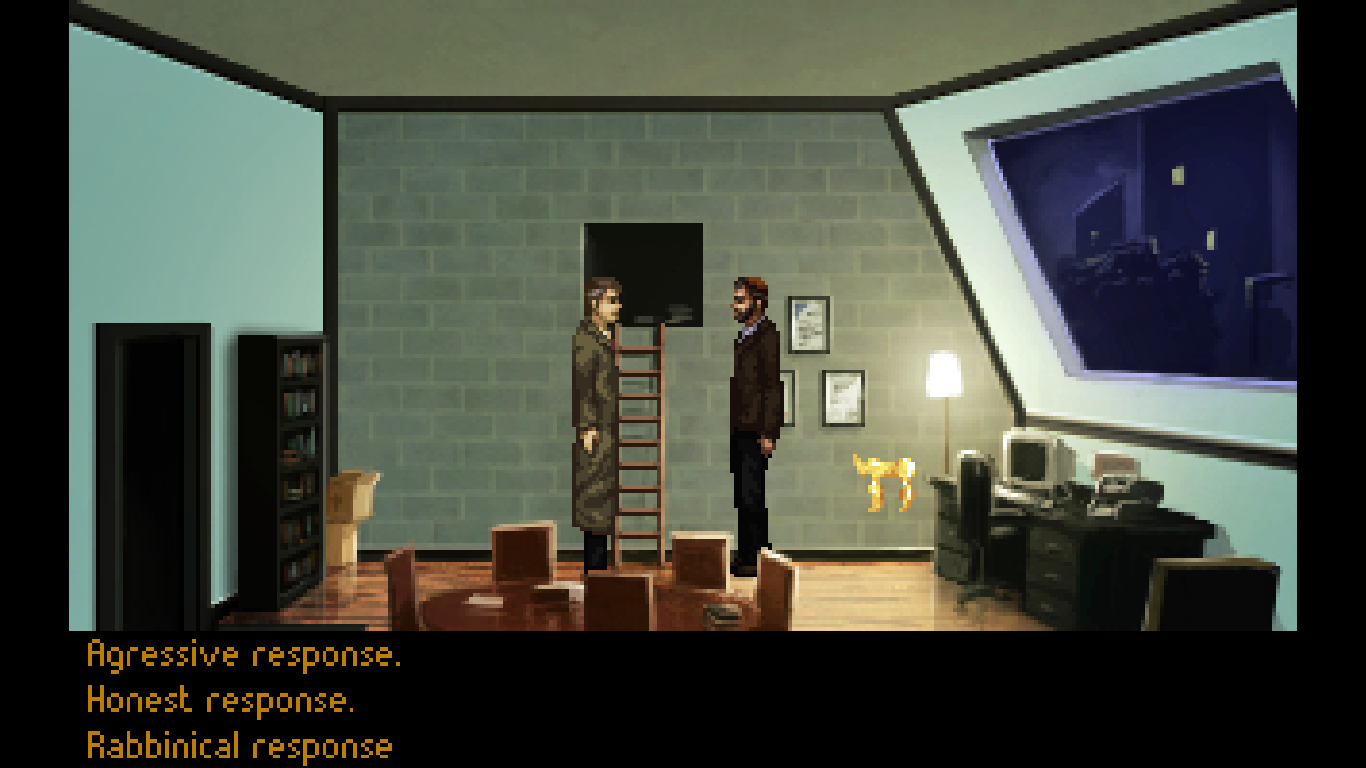
There’s not really a category for this game - you’re a rabbi investigating a murder in an old-school adventure game format. Although it is set within the Jewish New York culture, it is still accessible to those not of that culture and its themes are universal. Even as you explore for clues, the dialogue makes you question what it means to be wise, what is God’s will, and what it means to belong to a religious community. And there’s rabbinical fisticuffs.
Win The Game by Happy Backwards
(PC, Mac, Linux; free)
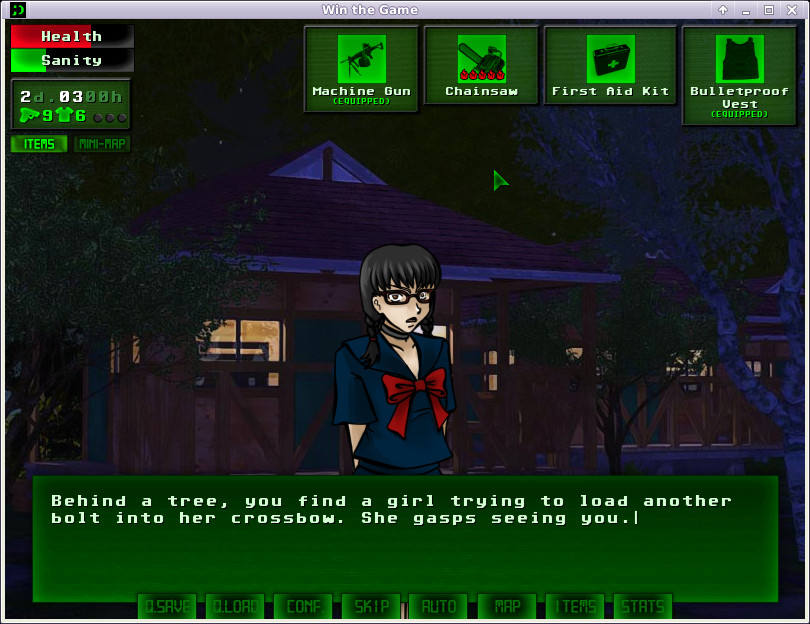
Actually being inside a fight-for-your-life game like the Hunger Games would be awful, no doubt about it. But, it turns out playing this game about that kind of survival scenario is not only strategic and adrenaline-pumping, but it’s also thought-provoking, morbid, and… fun? Maybe it shouldn’t be fun. But it is!
Aloners by Sonnet009
(PC, Mac, Linux; free)
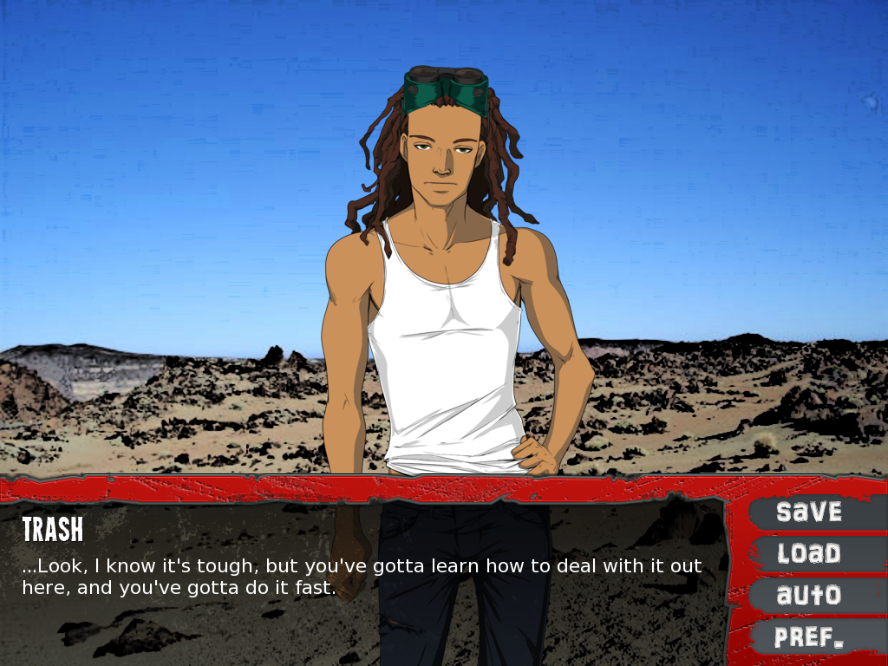
Post-apocalyptic romance is a saturated genre right now-- but this gem stands out above the rest for its flexible main character choices, characterization, and backstory. While a lot of items in this genre suffer from too much romance or too much action, this visual novel gets the balance just right, with intricate character building and relationship exploration interspersed with wasteland scavenging and life-threatening situations.
Who Is Mike? by FERVENT
(PC, Mac, Linux; free)
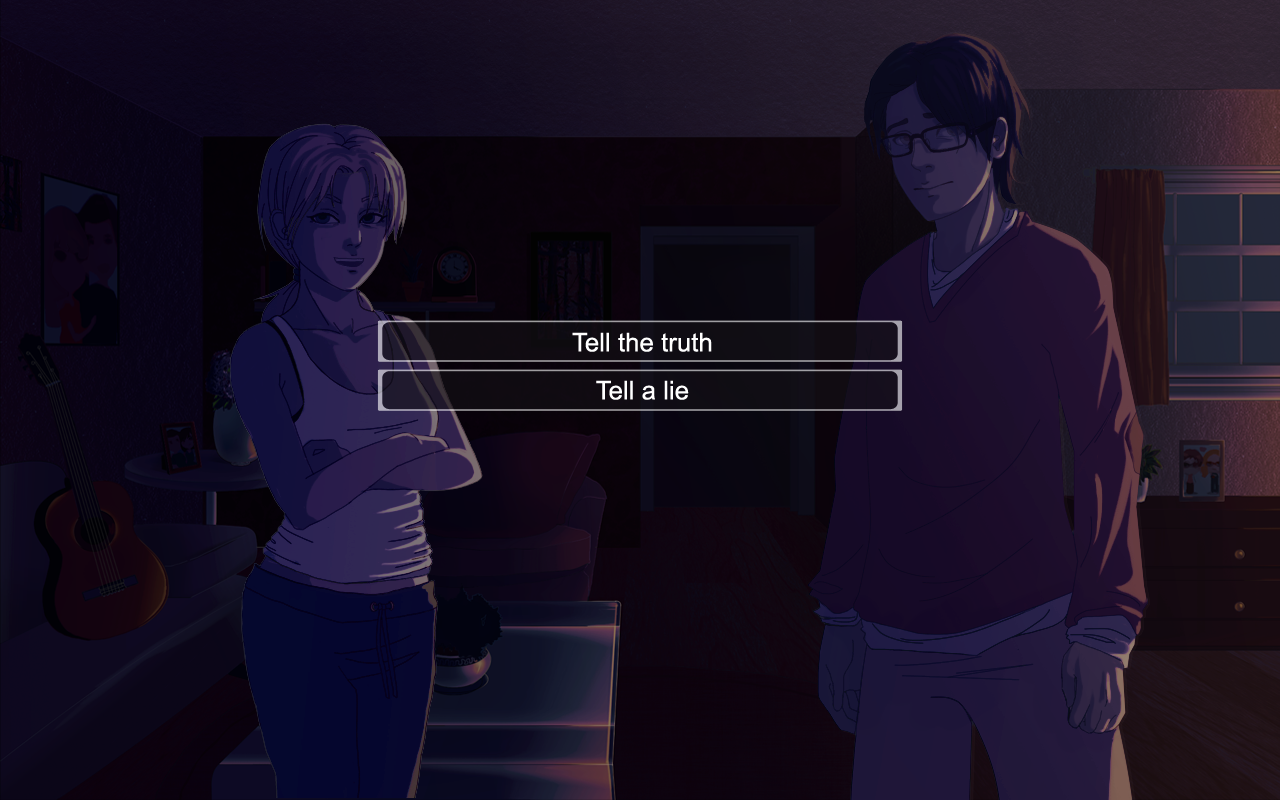
This psychological horror visual novel starts with you waking up in the same room as an identical doppleganger. One of you has to be real. Could you both be real? Or maybe one of you is trying to take over the real person's life. It has you wondering who the real enemy is, and seriously causes you to pause and consider if it might actually be YOU. Don't stop until you've seen all the endings to make sure you see all of this clever story full of twists.

Sunday, March 23, 2014
Indier than Thou (Visual Novel Review)
It's pretty cool to be an indie game developer these days. But while some have seen great commercial success, there are plenty of great indie games that people haven't played simply because they don't know about them. Some may also think that if a game is free, it must not be any good.
This is even more true for visual novels. Visual novels still seem to be in a somewhat awkward niche between “real computer games” and choose-your-own-adventure novels. That is unfortunate, because these are some of the best interactive fiction I’ve read lately, with powerful twists and realistic characters and a lot of emotional impact. Since they are available for free for Windows, Mac, and Linux, you really have no excuse not to at least give them a try!
SOON

Time-travelling, mad science, and killer robots are great and all, but they are not enough to make a good story. But SOON is not just a romp through time and space - it also has funny, realistic characters we care about, who make tough choices and change over time. Your sympathies and goals will change as you change time in this choose-your-own-adventure visual novel reminiscent of Jason Shiga’s Meanwhile.
The Dreaming
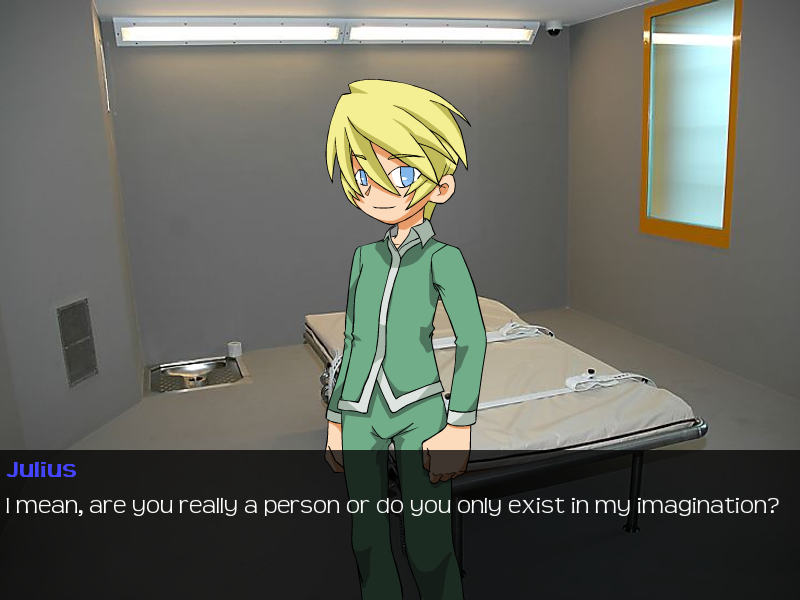
Don’t be deceived by the simplistic anime art style - this is psychological horror of the best kind. While movies can sometimes make you feel some of the things the main character feels, games and visual novels are a much better medium for really experiencing complex emotional questions such as “Is this real?”, "How can I help someone who seems delusional?" and “Would I know it if I was insane?”.
Romance is Dead

This quirky supernatural romantic tragicomedy’s greatest strength is its characters. The main character’s witty dialogue and intelligence are a refreshing contrast to the angsty indecisiveness so often found in the romance genre. It’s definitely worth replaying several times to uncover each character’s secrets, past, and true motivations. The jazzy music lends a distinctively New Orleans flavor to the game as well.
Adrift
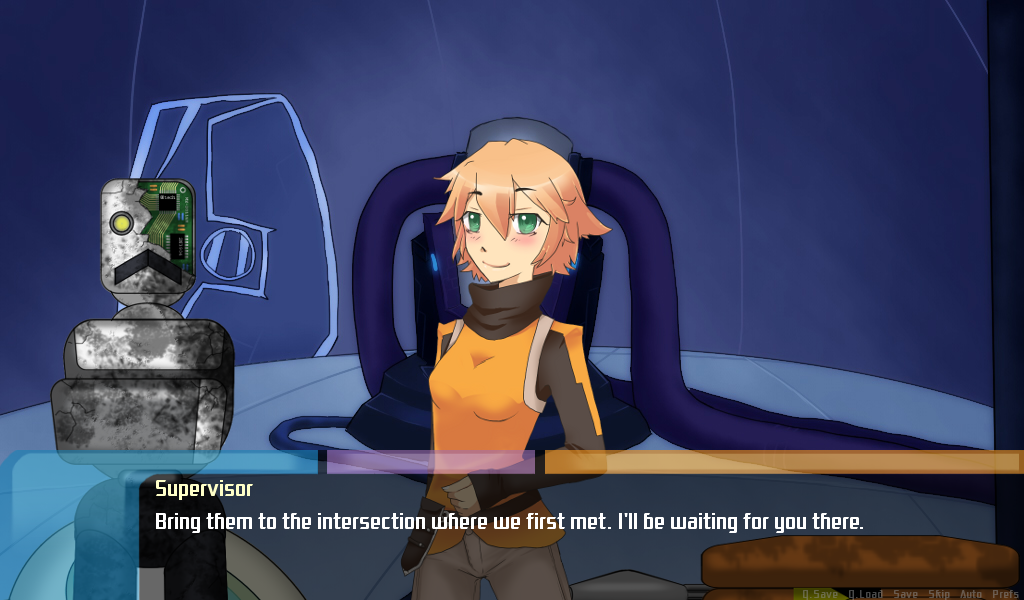
In Adrift, you are the human in charge of an underwater city, but your body is locked away in a stasis chamber. You must get both robots and humans to be your eyes, ears, and hands in this game that will test your perception, management skills, and creativity.
Tuesday, January 28, 2014
Radiant Historia is actually pretty linear
Radiant Historia is often lauded for being "non-linear." It's a JRPG for the Nintendo DS in which your character experiences "standard" and "alternate" history of his time, and can revisit events in the past with his knowledge from the future. It's a fairly cool premise, I mean, instead of "you have a sword save the world!" it's "you have the power to change certain aspects of the past based on the future so save the world!"
It's almost as non-linear as a novel, except you can't peak at anything further ahead than your current point in the game. I guess I felt excited that I could make choices in the game, but there were only a few choices that actually affected the ending. Most of those choices are in sidequests that are easy to miss (some of which I did miss. Don't worry, I watched the True Ending online). The main storyline choices are "ending that lets you keep going" and "bad ending." I wish that there had been more branches and a better illusion that there wasn't always one right choice. Maybe you need a less epic story to have multiple "okay" endings; where the world ending because of something you did isn't the default "wrong."
Radiant Historia has a fairly interesting battle system. Enemies are in a grid and certain powers can move them around to overlap, and when enemies overlap you can hit both of them at once. Also, if you hit an enemy many times in a row, successive attacks do a little more damage. You can also change the turn order to get everyone doing stuff in exactly the right order. I don't think I properly appreciated this system until a walkthrough got me to string ten attacks in succession (and I think you get more XP if you do more attacks in a row). It makes me sorry that I didn't experiment with it more earlier.
If you're a fan of JRPGs, I recommend this one, especially if you liked Chrono Trigger, but don't expect a bazillion endings.
Friday, January 17, 2014
Broken Age Act 1 is satisfying, if short. A feminist reading of the ending.
I finished playing Broken Age Act 1 this morning. The ending was a clincher and I'm excited for Act 2. I'm happy to say that I figured out all the puzzles except for one on my own (maybe that means other people would find them too easy?). I've played some other adventure games recently, and one thing Broken Age did well was having the story move along enough that I felt engaged with it. I played Gabriel Knight over Halloween and it also slowly revealed things so that I wanted to keep playing to see where the story went. It had narrative urgency. Broken Age wasn't quiiiite as page-turny, but it was much better than the newer Sam & Max games and the Wallace and Gromit point-and-click adventures (which I stopped playing after an hour or so and feel no need to go back to).
So, not only does Broken Age have narrative urgency, which I consider important in any story-based game, but it also had an interesting narrative--two worlds with details to indicate that they have some yet-unrevealed histories; the feeling that the world is bigger than the little parts you're seeing. The game isn't so dominated by humor that it feels forced, although at times I felt like I was growing out of the humor it had (hanging by your underwear and tree barf are only so funny at my age). I recommend the game, and that you keep playing to the end of Act 1!
Okay, I wanna discuss the ending! Major spoilers!
SPOILERS
MAJOR
Vella starts out sacrificed to this Mog Chothra, whom she escapes. Shay escapes mother computer to save creatures from hostiles... but his wolf guide seems to always want to leave before he picks the last one. Shay's ship sustains a hull breech in the last rescue. When Vella conquers Mog Chothra, Shay comes out of it. Basically, his ship was actually this monster, and when he thought he was saving girls, he was acting as a monster eating them. If I understand that right.
I was contemplating this situation. It lends itself to many interpretations, but a feminist/post-colonialist interpretation could see it as how those with more power are unaware of how they oppress those with less power, because they essentially live in different worlds. You really get a sense of how Shay thought he was really helping those "beings" he rescued. I felt sympathetic when he wanted to save every last one! But I think in the same way we can look back on, say, forcing indigenous people into Christian missions, or telling women they're inherently better in some ways because they're women (i.e., benevolent sexism), to one group they look like they're being helpful, but to the other they're not. I felt really insightful when I thought it, but now that I've written it down it seems kind of plain. Rampant Coyote saw it as a critique of the game industry, and I'm curious if he'll still see it that way after he plays the ending. What about you, who are reading this spoilery bit? I'm curious to know what other people thought of the ending.
So, not only does Broken Age have narrative urgency, which I consider important in any story-based game, but it also had an interesting narrative--two worlds with details to indicate that they have some yet-unrevealed histories; the feeling that the world is bigger than the little parts you're seeing. The game isn't so dominated by humor that it feels forced, although at times I felt like I was growing out of the humor it had (hanging by your underwear and tree barf are only so funny at my age). I recommend the game, and that you keep playing to the end of Act 1!
Okay, I wanna discuss the ending! Major spoilers!
SPOILERS
MAJOR
Vella starts out sacrificed to this Mog Chothra, whom she escapes. Shay escapes mother computer to save creatures from hostiles... but his wolf guide seems to always want to leave before he picks the last one. Shay's ship sustains a hull breech in the last rescue. When Vella conquers Mog Chothra, Shay comes out of it. Basically, his ship was actually this monster, and when he thought he was saving girls, he was acting as a monster eating them. If I understand that right.
I was contemplating this situation. It lends itself to many interpretations, but a feminist/post-colonialist interpretation could see it as how those with more power are unaware of how they oppress those with less power, because they essentially live in different worlds. You really get a sense of how Shay thought he was really helping those "beings" he rescued. I felt sympathetic when he wanted to save every last one! But I think in the same way we can look back on, say, forcing indigenous people into Christian missions, or telling women they're inherently better in some ways because they're women (i.e., benevolent sexism), to one group they look like they're being helpful, but to the other they're not. I felt really insightful when I thought it, but now that I've written it down it seems kind of plain. Rampant Coyote saw it as a critique of the game industry, and I'm curious if he'll still see it that way after he plays the ending. What about you, who are reading this spoilery bit? I'm curious to know what other people thought of the ending.
Tuesday, July 9, 2013
Animal Crossing: New Leaf. Explanation of what it is and its appeal.
I've given in and I started playing Animal Crossing: New Leaf. I hesitated for a long time because I had tried City Folk for the Wii and found it kind of boring. I guess I feel like if I'm going to go to the trouble of booting up the Wii, I should be able to play something and get a tangible amount of progress done towards winning a game. But for some reason on the 3DS I've stuck with it thus far (I suspect that its trendiness, and the non-demandingness of the 3DS contributed). I'm both impressed and overwhelmed by how this game expects me to play almost every day.
If you haven't played any Animal Crossing games, it's kind of like the Harvest Moon franchise, in that you harvest/gather/catch various things and sell them at a profit, except Animal Crossing occurs in real time. So there are certain things that only happen on Sundays, and holiday events for things like Christmas and Halloween. In New Leaf, you are the mayor of a little town, complete with animal neighbors who ask you to give them things and make up catch phrases for them.
Aside from the ecological carnage you can inflict (uprooting flowers, catching endangered fish, and chopping down trees being foremost), the game is non-violent. The social features of New Leaf are probably the best I've seen for a 3DS game (okay, they're the only online features I've ever used in a Nintendo game, period). If you so choose, you can open your town up to having visitors from your list of 3DS friends, or you can go visit them. You can visit the villages of non-friends through the dream world, and you can play minigames internationally through the island.
Having friends who will let you visit their town is also strategically important, as your home village fruit sells for more in other towns, and if you get into turnips you stand a better chance of not losing all your money if your friend has a spike in turnip prices while yours are declining (it's called the stalk market). I love how the social features aren't vital but make certain aspects of the game easier.
The day-to-day play of New Leaf isn't very gripping. You can dig up fossils, talk to your neighbors, buy furniture/clothes, and donate new creatures to the museum. I think the real satisfaction from New Leaf comes from watching your town and collections grow. Of course, all the hours you put in increase your emotional attachment to the game too. It's not just about collecting things though. It's also about how you display your items and how you design your town.
In some ways New Leaf is like a more contained version of Minecraft. If you're good at pixel art, you can make custom designs for floors, walls, furniture, and clothing right in the game. It's possible to make your own skin for your Minecraft character, but it's not as accessible. Sharing and stealing patterns is also really easy in New Leaf; just scan a QR code and you're done. None of this downloading a file, putting it in the right directory, and rebooting stuff. It's really fun to wear a dress designed by someone in Japan, or put down a tile set designed by a hardcore fan. I hope other games can incorporate these creative features, because they're really fun (it reminds me of Little Big Planet and Sound Shapes)! Now if only I could create a cool tileset...
PS Check out this horror village, Aika village, that someone made their animal crossing town into (start around 4 minutes in). Remarkable!
If you haven't played any Animal Crossing games, it's kind of like the Harvest Moon franchise, in that you harvest/gather/catch various things and sell them at a profit, except Animal Crossing occurs in real time. So there are certain things that only happen on Sundays, and holiday events for things like Christmas and Halloween. In New Leaf, you are the mayor of a little town, complete with animal neighbors who ask you to give them things and make up catch phrases for them.
 |
| typical AC |
Having friends who will let you visit their town is also strategically important, as your home village fruit sells for more in other towns, and if you get into turnips you stand a better chance of not losing all your money if your friend has a spike in turnip prices while yours are declining (it's called the stalk market). I love how the social features aren't vital but make certain aspects of the game easier.
The day-to-day play of New Leaf isn't very gripping. You can dig up fossils, talk to your neighbors, buy furniture/clothes, and donate new creatures to the museum. I think the real satisfaction from New Leaf comes from watching your town and collections grow. Of course, all the hours you put in increase your emotional attachment to the game too. It's not just about collecting things though. It's also about how you display your items and how you design your town.
 |
| dragon quest tileset |
In some ways New Leaf is like a more contained version of Minecraft. If you're good at pixel art, you can make custom designs for floors, walls, furniture, and clothing right in the game. It's possible to make your own skin for your Minecraft character, but it's not as accessible. Sharing and stealing patterns is also really easy in New Leaf; just scan a QR code and you're done. None of this downloading a file, putting it in the right directory, and rebooting stuff. It's really fun to wear a dress designed by someone in Japan, or put down a tile set designed by a hardcore fan. I hope other games can incorporate these creative features, because they're really fun (it reminds me of Little Big Planet and Sound Shapes)! Now if only I could create a cool tileset...
PS Check out this horror village, Aika village, that someone made their animal crossing town into (start around 4 minutes in). Remarkable!
Thursday, February 14, 2013
Depression Quest!
For a long time, I've been somewhat fascinated by depression. I've had friends who suffered from it. I studied psychology in college, and depression was a part of those studies. I've read personal essays and fiction describing the abyss and clustercuss that is a depressive episode. But none of these experiences have made the experience as clear as Zoe's Depression Quest (well, Zoe Quinn and Patrick Lindsey). If you choose to isolate yourself and give in to feeling crummy, your depression gets worse. These negative feedback loops are the things that feed depression. But you can't "just do" things or snap out of it--depending on your depression level, certain options will be unavailable.


Playing this game fills me with compassion for those who suffer from depression. It also helps me recognize my own "depressive"* thoughts--like when it seems like everyone is doing cooler things than me, or when I feel useless, or when I don't feel like talking to anyone I haven't known for more than two years. I think everyone should play this game--it will make you more compassionate and understanding if you haven't suffered from depression, and it might help you feel like you're not alone if you have.
*I don't have clinical depression. But we all get down sometimes.
Friday, February 8, 2013
Ni no Kuni is bringing the airship back
"I want an airship in my game. Not an airship where you just select where you want to go, but one you can actually move around the world in." This was my husband's one stipulation about what an RPG should have. After a bit of discussion, I wasn't sure if such a game existed this-gen (although I think Tales of the Abyss has one). I remember googling "airship JRPG" to try to find a JRPG with whole-world exploration, and not being able to find one (it's not the most searchable topic... so please comment with your favorite explorable JRPGs).
So you can imagine how we've been enjoying Ni no Kuni, the JRPG that incorporates some aspects of old-school design (including a way to explore the world aerially), while at the same time making the genre highly accessible.
And by "accessible," I mean, "a good introduction to JRPGs for this generation." Some JRPGs get difficult very quickly, and require strategies that a 10-year-old might not think of. I'm glad we have games that are difficult, but I still appreciate games that are made with children and adults in mind; Ni no Kuni does this excellently. The pun-filled "pieces of art" quests might go over a few kids' heads, but they made me chuckle. I don't mind that Drippy always tells me how to beat a boss, and I've enjoyed playing on easy to just enjoy the exploration and story.
Being able to explore a world is key to my enjoyment of an RPG. In some games the amount of possible exploration is overwhelming (like Oblivion), but I'd prefer that to a railroaded course like in FFXIII. Repeatable battles still strike me as a way to extend the "fun" content of exploring and story-reading, which makes me wonder if I'd like an RPG that completely got rid of combat (I probably would; I really enjoyed To the Moon).
Combat in Ni no Kuni is what has bothered me the most. In an effort to make the game easy for children to understand, the AI controls are very minimal (but exist!). It's very common for an ally to dump all their MP out on a battle they could have won using only one ability (the alternative is "no abilities"). It's probably a sign that I've matured in my RPG strategies; I doubt I would have cared about ally AI as a teenager.
The lack of AI control is completely forgivable given how well-written and gorgeous the art is. The creatures you fight have funny names like in Pokemon--one chick creature is a "Teeny Bopper" while a cat creature is a "Purrloiner." Yes, it's that kind of humor.

Have you been enjoying Ni No Kuni? I-I think you would probably like it.
So you can imagine how we've been enjoying Ni no Kuni, the JRPG that incorporates some aspects of old-school design (including a way to explore the world aerially), while at the same time making the genre highly accessible.
And by "accessible," I mean, "a good introduction to JRPGs for this generation." Some JRPGs get difficult very quickly, and require strategies that a 10-year-old might not think of. I'm glad we have games that are difficult, but I still appreciate games that are made with children and adults in mind; Ni no Kuni does this excellently. The pun-filled "pieces of art" quests might go over a few kids' heads, but they made me chuckle. I don't mind that Drippy always tells me how to beat a boss, and I've enjoyed playing on easy to just enjoy the exploration and story.
Being able to explore a world is key to my enjoyment of an RPG. In some games the amount of possible exploration is overwhelming (like Oblivion), but I'd prefer that to a railroaded course like in FFXIII. Repeatable battles still strike me as a way to extend the "fun" content of exploring and story-reading, which makes me wonder if I'd like an RPG that completely got rid of combat (I probably would; I really enjoyed To the Moon).
Combat in Ni no Kuni is what has bothered me the most. In an effort to make the game easy for children to understand, the AI controls are very minimal (but exist!). It's very common for an ally to dump all their MP out on a battle they could have won using only one ability (the alternative is "no abilities"). It's probably a sign that I've matured in my RPG strategies; I doubt I would have cared about ally AI as a teenager.
The lack of AI control is completely forgivable given how well-written and gorgeous the art is. The creatures you fight have funny names like in Pokemon--one chick creature is a "Teeny Bopper" while a cat creature is a "Purrloiner." Yes, it's that kind of humor.
Have you been enjoying Ni No Kuni? I-I think you would probably like it.
Wednesday, November 21, 2012
HEY ICE KING: Why'd you steal our garbage? Review
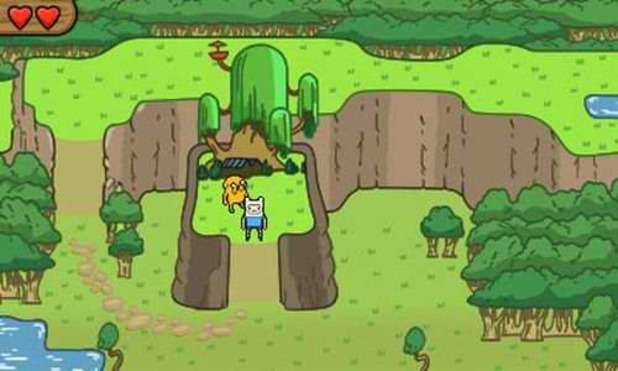
I've been anticipating this game with much excitement! I played through it yesterday and this morning and it is excellent (if a bit short)! The Adventure Time DS/3DS game is fun for any fan of the series. My husband who is not as big of a fan said it looked fun too. It's a 2D action/adventure game, and I think an old-school game deserves an old-school review. So here we go!
THE GAMEPLAY: People have been saying it's a lot like Zelda II. The enemy encounters and walking everywhere on the minimap are like Zelda II, but the difficulty is not. It was easy enough for me to beat, and I suck at Zelda games. For those who like more challenge, supposedly the New Game+ is a little more difficult. You hit enemies with one of several moves to do damage; if you can't avoid them you take a hit.
Food lying around gets you health back, as do the numerous save points. You can combine condiments with food to make it better, but only if you find the right combination (I put wildberry jam on a royal tart and it actually hurt me when I ate it). Oh, and I think apple pies are probably the best healing thing in the game.
There were lots and lots of items to give you temporary powers. I tended to save them up instead of using them... the only ones I was glad I saved was a bomb for a boss, and some wings to get to a certain area sooner. The others I think I should have used as soon as I got them so I could have had more room in my inventory for food.
I loved the save points in this game. They were always there when I needed one, and since they give you full health, they cut down on the need to constantly chomp down on hamburgers.
THE STORY: You're running around on fetch quests trying to find the Ice King, who stole your garbage. You get to interact with many characters from the TV show, and it's hilarious. I laughed out loud several times.
A few times I was feeling stuck and almost stopped playing, but I thought "I'll just go back here or explore this next area" and that always worked. Like I said, the game wasn't very long, but I'm actually glad it didn't get much harder. It might have been cool to have one more area in outer space or something, but the arc of the game felt good, and I wasn't sick of playing when it ended.
THE MUSIC: I loved it. I think my favorite was the little remix of the theme song for the victory music. I didn't care for the song playing on the title (the theme only covered by a different band), but the rest matched my expectations for zelda and megaman-themed music. The final boss theme song was also hilarious and awesome.
THE GRAPHICS: Cute and perfect.
THE COLLECTOR'S EDITION: The map was the map from the game and... not all that cute, although I guess they were going for a retro feel, which I understand. The little monster guide booklet had some cute copy in it. The sword stylus is cool, but this game doesn't use the stylus that much, so I might have to use it for some other game. The Enchiridion case is awesome, and since I'm a big fan it was worth the extra $10 to get some goodies. Otherwise it's probably not worth it (like most collector's editions).
PERFECT FOR: Children with a 3DS who are old enough to read and understand information (it's all text), and fans of Adventure Time.
THE GAMEPLAY: People have been saying it's a lot like Zelda II. The enemy encounters and walking everywhere on the minimap are like Zelda II, but the difficulty is not. It was easy enough for me to beat, and I suck at Zelda games. For those who like more challenge, supposedly the New Game+ is a little more difficult. You hit enemies with one of several moves to do damage; if you can't avoid them you take a hit.
Food lying around gets you health back, as do the numerous save points. You can combine condiments with food to make it better, but only if you find the right combination (I put wildberry jam on a royal tart and it actually hurt me when I ate it). Oh, and I think apple pies are probably the best healing thing in the game.
There were lots and lots of items to give you temporary powers. I tended to save them up instead of using them... the only ones I was glad I saved was a bomb for a boss, and some wings to get to a certain area sooner. The others I think I should have used as soon as I got them so I could have had more room in my inventory for food.
I loved the save points in this game. They were always there when I needed one, and since they give you full health, they cut down on the need to constantly chomp down on hamburgers.
 |
| img src |
A few times I was feeling stuck and almost stopped playing, but I thought "I'll just go back here or explore this next area" and that always worked. Like I said, the game wasn't very long, but I'm actually glad it didn't get much harder. It might have been cool to have one more area in outer space or something, but the arc of the game felt good, and I wasn't sick of playing when it ended.
THE MUSIC: I loved it. I think my favorite was the little remix of the theme song for the victory music. I didn't care for the song playing on the title (the theme only covered by a different band), but the rest matched my expectations for zelda and megaman-themed music. The final boss theme song was also hilarious and awesome.
THE GRAPHICS: Cute and perfect.
THE COLLECTOR'S EDITION: The map was the map from the game and... not all that cute, although I guess they were going for a retro feel, which I understand. The little monster guide booklet had some cute copy in it. The sword stylus is cool, but this game doesn't use the stylus that much, so I might have to use it for some other game. The Enchiridion case is awesome, and since I'm a big fan it was worth the extra $10 to get some goodies. Otherwise it's probably not worth it (like most collector's editions).
PERFECT FOR: Children with a 3DS who are old enough to read and understand information (it's all text), and fans of Adventure Time.
Saturday, November 17, 2012
Play Therapy and Asperger's Syndrome
A while back I wrote a post about "ludotherapy," or using videogames as a springboard for discussion in psychotherapy. Kevin Hull, who wrote the dissertation I discussed there, e-mailed me and mentioned he wrote a book related to his dissertation, and I asked him for a copy in exchange for writing about it. My bachelor's is in psychology, and I worked with children in high-conflict divorces for a brief time, which often included playing with them. This was my first time reading an entire book about play therapy, and it makes me want to read more.
The structure of Play Therapy and Asperger's Syndrome is highly organized with specific play therapies recommended for the problems children with Asperger's typically encounter. Hull's approach is anecdotal (with a few citations where needed), and he stresses the need to adapt techniques to each individual. There's no one chapter on videogames, but rather, the book is organized by problem type with videogames as a resource for addressing several different problems. I was struck by Hull's high level of respect for children and teens with Asperger's, which seems fitting of a child therapist. My own eye-rolling to the constant reference to "these remarkable young people," made me think I should stop being such a cynical reductionist about certain types of people.
So what is play therapy? It's more than a way for a child to feel comfortable talking with the strange adult who is their therapist. It's also a safe, nonverbal space for them to express their fears and insecurities. With videogames, it often becomes a way to teach children that they can transfer their skills of persistence and problem-solving to the real world.
Reading about play therapy made me excited to see children and try out some of the techniques myself—things like telling a child what they're doing to let them know you're watching them, or with older children (and adults), talking about how the themes from a videogame can help us cope with our anxieties and other problems. With videogames specifically, the "game as metaphor" technique was the most common Hull mentioned. Here's an example:
Hull has another technique where he has the child play Tetris on a very high level, with the intent of frustrating the child. The frustrating experience provides a setting to learn and apply principles of relaxation and controlling your emotions that is a real test of those skills! I find these examples of teaching and practicing coping skills to be an excellent example of what applied psychology/psychotherapy should do well. I wonder if teaching adolescents to think about game design (why a level was made the way it is) could help them think more about how other people think and feel.
As adults, we are in a similar situation with videogames. We can play them "just" for fun, though some games are positioned to teach specific lessons. But I would argue that for any game, discussing the experience will make it more meaningful and applicable to our daily lives. I think that's why I feel passionate about videogame criticism; it's not just that I love videogames, but that thinking about them makes my own life richer. It's a way for me to contemplate life while still focusing on an experience in itself (playing a game).
In short, play therapy sounds like an excellent way for children and teens (and I would argue, adults) to express themselves. If you are a parent, I would encourage you to take a little time to play with your children, even if it seems awkward or you don't have a lot of time (children are impressed when you play with them! Even once a week can make a difference). I highly recommend this book to any child psychologist who deals with clients with Asperger's, and also parents of children with Asperger's and anyone interested in play therapy. It's a little on the expensive side to read on a whim, but if you're in college you can probably get the book on ILL. Next time a child asks "can you play with me?" think of it as an opportunity to enter their imaginative world! :-)
The structure of Play Therapy and Asperger's Syndrome is highly organized with specific play therapies recommended for the problems children with Asperger's typically encounter. Hull's approach is anecdotal (with a few citations where needed), and he stresses the need to adapt techniques to each individual. There's no one chapter on videogames, but rather, the book is organized by problem type with videogames as a resource for addressing several different problems. I was struck by Hull's high level of respect for children and teens with Asperger's, which seems fitting of a child therapist. My own eye-rolling to the constant reference to "these remarkable young people," made me think I should stop being such a cynical reductionist about certain types of people.
So what is play therapy? It's more than a way for a child to feel comfortable talking with the strange adult who is their therapist. It's also a safe, nonverbal space for them to express their fears and insecurities. With videogames, it often becomes a way to teach children that they can transfer their skills of persistence and problem-solving to the real world.
 |
| img source |

The "clones" from Lego Star Wars that constantly try to attack the player and thwart progress can illustrate bullies. Challenges that have to be completed to get to the next level can be used as metaphors for conquering fears and getting through situations that the child diagnosed with AS views as unpleasant. When a metaphor presents itself, I push the pause button on the controller to stop the action to explain the metaphor.Merely playing a videogame is usually not enough to be therapeutic. It's the discussion of the game and how it applies to real life that makes the experience meaningful to a child. Hitting the pause button and saying "there, right there, you were brave."
Hull has another technique where he has the child play Tetris on a very high level, with the intent of frustrating the child. The frustrating experience provides a setting to learn and apply principles of relaxation and controlling your emotions that is a real test of those skills! I find these examples of teaching and practicing coping skills to be an excellent example of what applied psychology/psychotherapy should do well. I wonder if teaching adolescents to think about game design (why a level was made the way it is) could help them think more about how other people think and feel.
As adults, we are in a similar situation with videogames. We can play them "just" for fun, though some games are positioned to teach specific lessons. But I would argue that for any game, discussing the experience will make it more meaningful and applicable to our daily lives. I think that's why I feel passionate about videogame criticism; it's not just that I love videogames, but that thinking about them makes my own life richer. It's a way for me to contemplate life while still focusing on an experience in itself (playing a game).
In short, play therapy sounds like an excellent way for children and teens (and I would argue, adults) to express themselves. If you are a parent, I would encourage you to take a little time to play with your children, even if it seems awkward or you don't have a lot of time (children are impressed when you play with them! Even once a week can make a difference). I highly recommend this book to any child psychologist who deals with clients with Asperger's, and also parents of children with Asperger's and anyone interested in play therapy. It's a little on the expensive side to read on a whim, but if you're in college you can probably get the book on ILL. Next time a child asks "can you play with me?" think of it as an opportunity to enter their imaginative world! :-)
Thursday, August 30, 2012
Ghost Trick expertly uses elements of visual novels.
Whenever I have a hard time thinking of what I should write for a blog post, I try to think of a game I have played and not written about. Usually I'm like "ahhh I had things I wanted to say while I was playing this and forgot all about them!" So my advice to myself is: if you play a game, write about it. I've been trying to cover some more obscure things over at Kill Screen (maybe to a fault). And it's kind of hard to find stuff sometimes! I spend a lot of time curating--reading over news from various sites and mulling over whether or not our readers would find it interesting. I should probably get less picky because it's ridiculous how much time it can take (or not take).

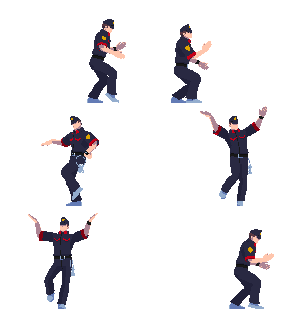
ANYWAY, what I really wanted to write about is how Ghost Trick basically addressed all my complaints in my post about what visual novels should learn from comics. Short recap: Things that bug the heck out of me in visual novels are 1) information redundant to the artwork, 2) artwork that doesn't pack much information in it, and 3) a slow pace. Ghost Trick avoided all of these. The narration didn't tell me things I already knew from visual information (though it did review information I needed to make sense of the plot). Characters had unique animations that brought out their personalities:
The game ended about where I was beginning to tire of the mechanics, and had a satisfying, if ridiculous, ending. It was really fun to see a game execute parts of visual novel style in such an excellent way. Some might argue that it's not really a visual novel, in which case I might just have to admit that I don't particularly like visual novels as a genre.
I feel bad about disliking most visual novels... but I think if I'm going to spend all that time reading on a bright screen I want to have some interaction with the story. If there isn't some kind of gameplay (like the puzzle sections in Ghost Trick or 999), or a branching storyline, then I might as well be reading a comic book, in my mind.
I started playing around with Ren'Py, the python-based visual novel engine, and immediately I wanted to learn about things like making choices and keeping track of statistics. I think it's more about how the elements of visual novels combine with others that make it interesting (I find reading scripts for plays terribly boring, but generally enjoy seeing them... I see visual novels as a game that's missing vital parts). On the other hand, I can see how for a budding designer, learning one or two parts of a game at a time could be really useful, fun, and instructive. Feel free to share about why I shouldn't give up on visual novels!
Thursday, February 16, 2012
Dear Esther's setting matches its emotional push
The most memorable part of Dear Esther is its setting: an island off the coast of the UK containing a cave and some abandoned buildings. Walking through it felt a little like watching LOST--hope for some awesome, supernatural explanation, and disappointment with an ending that brought up more questions than it answered. And like LOST, the setting is a mysterious island often described in metaphorical terms.
In my Western-American literature class, we often discussed the importance of the western setting. Wide open plains and awe-inspiring mountains evoke a fear and respect for nature, and feelings of freedom but also oppression (it's contradictory. It's literature). The island and cave had a different significance. The narrator explored his own feelings about being on the island and towards Esther, and such introspection seems even more fitting inside the earth. Climbing up the island and the final descent accompanied the rising realizations and letting go. The focal point of this game at every moment is the place, places which evoke memories and hasten death.

At the same time, it's not just an island. It's hyperreal; it is more beautiful than real nature. And, like the setting, the story is better in my imagination than it is in the script. When I actually looked at the script, the story lost its mystery. It became an impressionistic, surreal kind of rambling, whose allusions shed little light on the actual events leading up to the narrator's arrival on the island. But at the same time, the experience of the game/hypertext was highly evocative of loneliness, loss, and confusion. The island is not a place in the physical world, it is a digital medium to evoke the bittersweetness of cold beauty that is completely unsentient, matched by memories of a loved and dead person. In this way, I believe Dear Esther succeeds in connecting its setting to its story.
And, this is completely changing the subject, but if you're curious about how to classify games in the literary scheme of thigns, Aarseth has an interesting system:
 |
| Aarseth's ergodic literature chart, which you can read more about here |
Some people have noticed that Dear Esther isn't really a game, or what game there is is purely evocative. The above chart comes from Aarseth's book Cybertext: Perspectives on ergodic literature. A branching path (even if it's not branching for very long) qualifies as explorative; if the text's appearance is in part chosen or created by the user, it is configurative, and permanent user additions make it textonic.
The interesting thing to me is that, because of its randomized sections, Dear Esther is a configurative cybertext--less pre-determined than other games like Portal. The difference is that with Dear Esther, there is no puzzle or non-story part besides walking. Also, I don't really think the randomization of text improves my experience with Dear Esther. It seems like a gimmick to make me re-visit the game, which I will probably do anyway next time I miss seeing the ocean.
Tuesday, November 15, 2011
Bastion as tragedy
Bastion is one of those little games that you kind of have to play to know what it's about, but I'll try to explain anyway. Gameplay-wise, it's an isometric action-rpg where you can change weapons, etc., and seems pretty normal to me. It's the story that makes this game worth playing.
 Warning: spoilers for Bastion ahead.
The cool thing about Bastion is that your narrator reacts to what you do--it really feels like he's watching. And he's... kind of unreliable. Not the first time there's been an unreliable narrator in video games, but I think it makes for a more exciting story. In addition, there's a gradually unfolding post-apocalyptic story where you find out the Calamity (apocalypse catalyst) was intended as a genocide of the Uras, a tribe of people your people didn't like, and that your narrator, Rucks, helped cause the Calamity.
You as the player must make two moral decisions at the end: the first is whether or not you save the Uran who betrayed you, the second is whether to restore the world to how it was (before the Calamity, where your life was kinda crappy), or do you try to make a better civilization with the friends you have?
I'm a gullible person and I was taken into narrator Rucks's story. I wanted to help him undo his mistake, when undoing the Calamity probably just took everyone back to their pre-Calamity states of generational hate. I thought about what my character would do when confronted with his betrayer and I thought that he wouldn't save him, especially if he has to leave behind his weapon in order to carry his body. I ended up abetting genocide without trying to be the "bad guy." Granted, at first, the game doesn't let you choose whether or not to kill the Urans--they will keep attacking you no matter what.
Over at Line Hollis's blog, she's been discussing if it's possible for a video game to be a tragedy--for you to choose the wrong ending without trying to be a "bad guy." And I think Bastion does a pretty good job. I feel like a complete jerk for undoing the Calamity. And even if you do choose to save betrayer-dude and stay where you are, you're still in a post-apocalyptic land where it looks like you're going to have a hard life. But at least you'll be atoning somewhat for the hatred of your people.

The cool thing about Bastion is that your narrator reacts to what you do--it really feels like he's watching. And he's... kind of unreliable. Not the first time there's been an unreliable narrator in video games, but I think it makes for a more exciting story. In addition, there's a gradually unfolding post-apocalyptic story where you find out the Calamity (apocalypse catalyst) was intended as a genocide of the Uras, a tribe of people your people didn't like, and that your narrator, Rucks, helped cause the Calamity.
You as the player must make two moral decisions at the end: the first is whether or not you save the Uran who betrayed you, the second is whether to restore the world to how it was (before the Calamity, where your life was kinda crappy), or do you try to make a better civilization with the friends you have?
I'm a gullible person and I was taken into narrator Rucks's story. I wanted to help him undo his mistake, when undoing the Calamity probably just took everyone back to their pre-Calamity states of generational hate. I thought about what my character would do when confronted with his betrayer and I thought that he wouldn't save him, especially if he has to leave behind his weapon in order to carry his body. I ended up abetting genocide without trying to be the "bad guy." Granted, at first, the game doesn't let you choose whether or not to kill the Urans--they will keep attacking you no matter what.
Over at Line Hollis's blog, she's been discussing if it's possible for a video game to be a tragedy--for you to choose the wrong ending without trying to be a "bad guy." And I think Bastion does a pretty good job. I feel like a complete jerk for undoing the Calamity. And even if you do choose to save betrayer-dude and stay where you are, you're still in a post-apocalyptic land where it looks like you're going to have a hard life. But at least you'll be atoning somewhat for the hatred of your people.
Thursday, August 4, 2011
Humble Indie Bundle 3
You've probably heard about the third Humble Indie Bundle. You choose what you want to pay for five indie games (you could even just pay $0.01, though I think they're worth more than that). I love this idea; my problem is that I can never tell what kind of games are for sale. Well, fear no more. I'll do a quick rundown of each game in the bundle here (informed by 10 minutes to a few hours of play).
Crayon Physics Deluxe
 The main gimmick of this game is that you draw things and they act like real-world objects (there's a kind of Scribblenautish quality, only more primal because you don't have to name it). I quickly solved a puzzle the day after it stumped me, which I consider a sign of a good game. I still haven't figured out why some shapes seem to weigh more than others, but I like the idea and have enjoyed playing so far.
Cogs
 A steampunk puzzle game without a narrative, only the repeating missing-piece-shifting puzzles which are often frustratingly satisfying to solve. They get into 3D and double-sided, which makes my brain hurt, but in a good way.
VVVVVV
 A retro-styled platformer where you change gravity to proceed with the level. It sounds like it should be a puzzle game, but it quickly turns into a battle of reflexes (in the screenshot here, the rectangle in the upper right-hand corner is a platform that moves side-to-side, which you must touch on three times to get to the thing you probably don't really need). The graphics and sound effects are way cute, but I admit that I suck at this game.
Hammerfight
 It's hard to tell from the screenshot, but this is a fighting game. You control this flying thing with your mouse that has a big weight on the end, which you use to hit other, similar flying things. It's set in some kind of fantasy middle eastern setting? It has some pretty cool art. The gameplay is kind of bizarre; it's like throwing around a ball and chain (but I think it makes use of mouse movement in a way few other games do).
And Yet It Moves
 Along the same lines as VVVVVV, you control which direction is up. However, you must choose between four options instead of two (basically you can rotate the world 90 degrees whenever you want). Velocity is preserved over screen shifts, making it more of a puzzler than VVVVVV. Kind of cool to play around with, kind of frustrating to get stuck on a puzzle.
Along with these games comes Steel Storm, an overhead shoot-'em-up with stealth elements (you're a fighter plane). And, if you pay more than the average price (currently $5.35), you get the previous indie bundle too, which includes the tower defense game Revenge of the Titans. It is currently kicking my butt, and my husband is reminded that Plants vs Zombies is an easy tower-defense game. Maybe more about that later.
Crayon Physics Deluxe

Cogs

VVVVVV

Hammerfight

And Yet It Moves

Along with these games comes Steel Storm, an overhead shoot-'em-up with stealth elements (you're a fighter plane). And, if you pay more than the average price (currently $5.35), you get the previous indie bundle too, which includes the tower defense game Revenge of the Titans. It is currently kicking my butt, and my husband is reminded that Plants vs Zombies is an easy tower-defense game. Maybe more about that later.
Tuesday, June 28, 2011
SPOILER Portal 2 has a happy ending

Adam and I finally beat the co-op on Portal 2 so I feel like I can discuss the game. First, the good things. Co-op works pretty well, at least splitscreen, and it's fun. Sometimes it was frustrating that I wasn't always the one to find the solution to a puzzle, but that's the tradeoff when you play with someone as smart as you. It was a relief to be a robot and not be afraid of dying; funny how much that affects my game experience. I think there's room for more co-op puzzle games in the world.
Of course Portal 2 is very fun, and the puzzles are just hard enough that you can keep feeling smart (and that takes some subtle scaffolding, let me tell you). The only parts I struggled were the "guess where to place the portal" puzzles, and I don't feel bad about getting stuck there. This is definitely a great game, but it 's not as narratively tight as Portal (see that discussion over at the Brainy Gamer). It's also not as experimental as Portal (full disclosure: still working on my thesis about Portal and House of Leaves).
Portal's narrative is exciting to me as a literature student because Chell doesn't win, but you as the player "beat" the game (and you get your cake). Meanwhile, GLaDOS sings about how she's definitely still alive. This overt acknowledgement that we don't actually care about the protagonists, but it's our experience as players that should be awesome, feels new and exciting (or post-modern, take your pick). Are there other games where the protagonist loses while you the player wins? I can't really think of any, but please comment if you think of one.

I might be reading too much into it. What was your experience with the Portal games like? Did you feel like GLaDOS won in Portal, or was that just an excuse to have a sequel?
Monday, June 20, 2011
My experience with Heavy Rain

When I played Heavy Rain for the first time, I felt impressed by the actual role-playing aspect. Oh, I'm a father, I should help with the groceries. I even got nervous when I couldn't find the dinner plates. This went on, except I grew frustrated by the limitations of the game. The game wouldn't let me leave a house to avoid killing a guy. I couldn't role play too far out of character; that option wasn't given.
I can chalk up lack of choices to realistic game limitations (you can only have so many branches), but the game did something I found unforgivable. My characters made decisions off-screen, without my knowledge. I felt this betrayed some unwritten rule of adventure/role-playing games: that when you play this game, your character's world is what you make for them. The ending is kind of like if you turned on a Zelda game and suddenly Link had betrayed Zelda and the world has ended. That just doesn't happen. I appreciate that the developers are trying to change what games can be, but I didn't feel that it was fun.
Part of the game asks how far I'm willing to go for someone I love. Well, my character will do anything in a virtual world where he doesn't get caught! Everything looks real, yet it's still in this weird game universe where you can do crazy things and not get in trouble. So the question of what I'm willing to do for someone I love turns into this meaningless quest-fulfillment (especially when I'm screaming inside, "go to the police, dumbbutt!"). I cannot deny the game's ability to creep me out or get me tense, but upon further reflection, my intense emotional reactions seem stupid.
Lastly, I was annoyed at how they seemed to try to fit every adult piece of content they could into this game. I guess I get tired of "gritty" games after a while; all the shooting, illegal drugs, swearing, and that one scene with the creepy guy were not my cup of tea. I know, it was rated M, what did I expect? I think I just associate "mature" with artful discussion of adult matters and not just reveling in them, but I think that most M-rated games are not really concerned with a serious discussion of adult issues. I wonder: if the game had been more carefree would I have enjoyed it more?
Tuesday, May 31, 2011
Nothing Stands in the Way of Love in Tomodatchi Collection
"I'm in love with my brother," my sister told me.
"That's forbidden," I told her, "It wouldn't be in harmony with the world." She became sad and I had to cheer her up with her favorite foods and a new outfit. Then she was back to normal, but we went through the same episode the next day. Where had my life gone so wrong?
I started playing a Japanese game for my DS called Tomodatchi Collection (Friend Collection in English). In the game you have an apartment building and you can make Miis (or send them from your Wii) to live in it. Once there, you can give them food, clothing, and interiors and they can make friends, fight, or fall in love with other Miis. It's the obvious sim extension of Miis. In fact, I was disappointed when I found out that Wii Miis had only appearances and no personality, and now this disappointment has finally abated.
The first Mii you make is yourself (so you are both a Mii and a huge god-hand), encouraging you to make Miis of people you know in real life. So I made Miis of my husband, my family, my in-laws, and some friends. This was a big mistake. I thought I told the game that these were my siblings, but apparently that can't get in the way of love! I was lucky enough for my husband to fall in love and successfully woo me (In the park, pridefully finally won me over [you can choose how they confess!]), but not all of my Miis ended with their intended pairs.
It's uncanny when the game gets personalities right (like when I found out that my husband's daisuki food was sukiyaki, or when my Mii got excited about wearing a suit), but since tastes are randomly generated, they're more often way off. Sometimes I can make the Mii look like the real person, but it breaks the likeness spell when my friend hates the cute gothic dress I got her or it turns out that my brother hates bread.
That complaint aside, it is a really cute sim game and has helped me practice my Japanese (if you've studied Japanese for about a year, you'll be able to get around in this game. Heck, you could probably figure it out not knowing any Japanese, it just wouldn't be as hilarious). I'm still finding out new things about the game a month later--like that I can hypnotize a Mii if I have a special item and make them dream about something.
And speaking of dreams... Mii dreams are awesome. Sometimes it's something as usual as falling or being unable to find a bathroom, but surreal dreams where you're helping your Mii jump from one parrot stand to the other just add the perfect zaniness to the game. I love this game to pieces, and I think I can tell why it's been one of the top ten DS games in Japan. Sim games aren't for everyone, but if they are for you, you will probably also love this game.
"That's forbidden," I told her, "It wouldn't be in harmony with the world." She became sad and I had to cheer her up with her favorite foods and a new outfit. Then she was back to normal, but we went through the same episode the next day. Where had my life gone so wrong?
I started playing a Japanese game for my DS called Tomodatchi Collection (Friend Collection in English). In the game you have an apartment building and you can make Miis (or send them from your Wii) to live in it. Once there, you can give them food, clothing, and interiors and they can make friends, fight, or fall in love with other Miis. It's the obvious sim extension of Miis. In fact, I was disappointed when I found out that Wii Miis had only appearances and no personality, and now this disappointment has finally abated.
The first Mii you make is yourself (so you are both a Mii and a huge god-hand), encouraging you to make Miis of people you know in real life. So I made Miis of my husband, my family, my in-laws, and some friends. This was a big mistake. I thought I told the game that these were my siblings, but apparently that can't get in the way of love! I was lucky enough for my husband to fall in love and successfully woo me (In the park, pridefully finally won me over [you can choose how they confess!]), but not all of my Miis ended with their intended pairs.
It's uncanny when the game gets personalities right (like when I found out that my husband's daisuki food was sukiyaki, or when my Mii got excited about wearing a suit), but since tastes are randomly generated, they're more often way off. Sometimes I can make the Mii look like the real person, but it breaks the likeness spell when my friend hates the cute gothic dress I got her or it turns out that my brother hates bread.
That complaint aside, it is a really cute sim game and has helped me practice my Japanese (if you've studied Japanese for about a year, you'll be able to get around in this game. Heck, you could probably figure it out not knowing any Japanese, it just wouldn't be as hilarious). I'm still finding out new things about the game a month later--like that I can hypnotize a Mii if I have a special item and make them dream about something.
And speaking of dreams... Mii dreams are awesome. Sometimes it's something as usual as falling or being unable to find a bathroom, but surreal dreams where you're helping your Mii jump from one parrot stand to the other just add the perfect zaniness to the game. I love this game to pieces, and I think I can tell why it's been one of the top ten DS games in Japan. Sim games aren't for everyone, but if they are for you, you will probably also love this game.
Tuesday, May 17, 2011
Ace Attorney Investigations: Miles Edgeworth
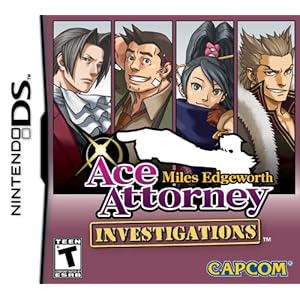
Imagine you're in some crime show, like Bones or Monk. Now, instead of watching and saying afterwards, "I knew it all along," you must actually prove your ability to predict the solution to crazy murder mysteries. That's Ace Attorney: Miles Edgeworth. Gameplay is limited to investigation (finding evidence and linking information with "logic") and interaction with witness/suspect testimony.
Superficial reactions: I've never played any of the other Ace Attorney games, but this one had a satisfying intertwining of initially disparate "chapters" of play. The script and character animations are fairly hilarious, though the distinctive music for each situation/character gets old by the end. Most of the time the obstacle is not figuring out what happened but figuring out how to tell the game that. For example, in order to use a piece of evidence that contradicts the witness's testimony, you must present it at exactly the right part of his testimony. It's remarkable that it works as well as it does, but it's frustrating when it's not as intuitive, as "dying" consists of replaying everything since your last save (booo-ring).
Controls: You can point and click with the stylus, but you can actually play the entire game without ever using the stylus. It's difficult to decide which is more desirable; buttons are more game-feeling but less precise when you want to point to that part of the screen, but using the stylus for a long time feels kind of weird. Oh, and you can use the "B" button to fast-forward through some text you've already seen.
Recommendations: I enjoyed the game more when I started playing in 30-60 minutes chunks. If like me, you play for 5-10 minutes and then pick it up again in a week, it's going to be frustrating to remember what's going on (although the game does provide useful hints as you flounder).
Cultural context: There is a lot of Japanese legal system culture that comes out in this game. The bizarre obsession with "truth," evidence, and the 100% confession rate are all a part of it. This NYTimes article sheds some light on the bad reputation Ace Attorney's prosecutors have. It claims that "Japanese authorities have long relied on confessions to take suspects to court, instead of building cases based on solid evidence," which also explains Ace Attorney's obsession with evidence, to the extent of absurdity in some situations. The Japanese courts do not allow plea bargaining, which explains the odd confession rate. Go read the article, and these games will make so much more sense.
Subscribe to:
Posts (Atom)