Friday, October 19, 2012
Traditional Halloween means more ghosts
In true hipster fashion I have been ruminating on the true meaning of Halloween. I read up on some old
customs, and I was struck by what has changed and what hasn't.
Things that haven't changed:
-dressing up
-trick-or-treating
-bobbing for apples/eating donuts on a string
-drinking cider
-jack-o-lanterns (granted, some were made with huge turnips, but same idea)
Things we don't do anymore:
-we don't go door-to-door for flowers to put on the graves of our ancestors so they won't haunt us
-we don't make cakes with objects that indicate our future luck (one tradition baked a key, ring, and thimble into a cake. If you got one in your piece, they represented a journey, marriage, and spinsterhood respectively).
-we don't do weird stuff with mirrors/apples to find out the initials of the person we'll marry
-tell ghost stories
In short, I wish our Halloween traditions were more superstitious!
One tradition gamers have is playing horror games (because duh!). I generally dislike horror--it's full of surprising, gruesome, and inexplicable things. And sometimes they're really scary, although I have yet to play a game that has me scared like books or films I've seen. What I would really like to play during Halloween times are games that deal with the supernatural.
Ghosts figure prominently in Blackwell Deception (still available for cheap at the Fall Indie Royale bundle). It's startling to see a ghost, because it means that person has died, but they aren't out to get you, necessarily. The ghosts act like regular people who don't know they're dead yet, for the most part. I also love the rumors in Persona 2 (well, I would love them if I could get anywhere in that game) and how the devils have little personalities. Less scary, more weird!
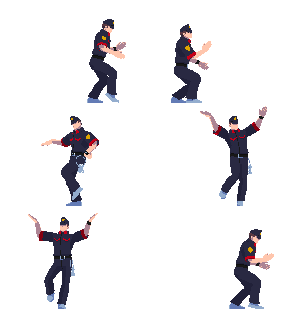
(my information on Halloween traditions came from The Halloween Book, which you can download for free from Forgotten Books. Or you could buy it on Amazon. The image is from the concept art for Guild War 2's Halloween update coming up on the 23rd.)
Thursday, October 4, 2012
Academic Interlude: Videogames as therapy for mental disorders
Last month I blurbed a study that made a videogame that senses various physical states and treated anger and anxiety. This game has been haunting me with how revolutionary it is. It's not just detecting brain waves like those cool moving cat-ear headbands. The game is connected to a system that measures sweat, blood oxygen levels, heart rate, skin temperature, and breathing. From these data, the game can tell what mood you're in (I think there are also facial and speech recognition tools in the software, but that's an even bigger piece to chew).
The researchers used a system called MobiHealth Mobile. This is what it looks like:
It's a lot less bulky than some biofeedback devices I've seen. Those little sensors probably go on your fingers.
Okay, so you have data about what the player's mood is. What can you do with that data? Well, you can tell when they're getting frustrated, and send them to meditate until they physically calm down.
Now, what if there were a game that undermined these goals? You could make a boss get tougher and tougher based on how frustrated (or how calm) the player was. Or a game where you don't die until your palms are sweating with anger. Or a dating sim that only gives you the suave lines if you're really calm. THINK OF THE POSSIBILITIES. Think of how immersive this would be combined with the Oculus Rift.
Here's a short gameplay video of Playmancer, which looks like some kind of a college senior project, but the impressive part about this game is the inputs, which unfortunately you can't see.
Source: "Video games as a complementary therapy tool in mental disorders: PlayMancer, a European multicentre study" by Fernando Fernandez-Aranda et al.
The researchers used a system called MobiHealth Mobile. This is what it looks like:
It's a lot less bulky than some biofeedback devices I've seen. Those little sensors probably go on your fingers.
Okay, so you have data about what the player's mood is. What can you do with that data? Well, you can tell when they're getting frustrated, and send them to meditate until they physically calm down.
When high undesired emotional and/or physiological reactions (e.g. anger feelings, impulsiveness, non-relaxed reactions, frustration, quick and unplanned responses) are detected by the video game, the game immediately directs the avatar to a relaxed area with the goal to calm down. During the whole game session, higher undesired emotional and/or physiological reactions are coupled with greater difficulty to reach the end goals of the video game (e.g. while diving the fishes are more difficult to catch, more obstacles appear in the mini-games). More relaxed and self-controlled reactions are positively reinforced by the game, making the situations easier to handle and the end goals easier to reach.In their game PlayMancer, the frustrating minigame is trying to collect things underwater while maintaining their oxygen level. In the calming game, more stars appear based on how relaxed you are.
Now, what if there were a game that undermined these goals? You could make a boss get tougher and tougher based on how frustrated (or how calm) the player was. Or a game where you don't die until your palms are sweating with anger. Or a dating sim that only gives you the suave lines if you're really calm. THINK OF THE POSSIBILITIES. Think of how immersive this would be combined with the Oculus Rift.
Here's a short gameplay video of Playmancer, which looks like some kind of a college senior project, but the impressive part about this game is the inputs, which unfortunately you can't see.
Source: "Video games as a complementary therapy tool in mental disorders: PlayMancer, a European multicentre study" by Fernando Fernandez-Aranda et al.
Thursday, September 20, 2012
Orson Scott Card on writing in videogames.
The Orson Scott Card writing in videogames workshop was today! It went from 8:30-5:30... so it was a long day. Luckily Card is funny and engaging. The workshop was made possible from a grant a UVU faculty member applied for... so good on him!
Highlights: Card is so amazingly fun to brainstorm with. I found myself being critical of other people's ideas, whereas he ran with them to make some really interesting scenarios (see the notes for details). Maybe I need to work on brainstorming more, since turning my critical mode off would really be useful once in a while.
I'm a fan of the Ender series, so hearing an author I like talk for a while was kind of mind-blowing (authors are real people!). I admire that he's done so much on his own and how he tries to show both sides of issues, and how there isn't always a right and a wrong to a situation, which I think videogames could really use (thanks, Bioware). But then again, since combat is such a big part of so many genres, there's kind of a need for an everlasting, ever-spawning enemy, which limits the kinds of stories you can tell.
Drawbacks: Card kept complaining that he hadn't seen any awesome SF/Fantasy writing in videogames... but he's not all that into videogames. He's content to play Civilization II, which is fine, but he made a lot of generalizations about the industry that I felt weren't as accurate as they might have been ten years ago (he hadn't heard of Skyrim or Minecraft... just sayin'). He was aware of Kickstarter though, and how the publishing model is dying, so he's not completely behind the times.
Card is a writer and as such, was pretty focused on linear storytelling in games. It's what he does best! But I'm also interested in how story and gameplay can merge.
I've scanned in my notes below in the interest of archival-ness and maximalism.
![]() |
| Proof that this actually happened |
Tuesday, September 18, 2012
Making a videogame is... really fun.
I participated in Adventure Time Game Jam! I made a game called When Sneezles Attack. I used the engine Twine, which was really easy to work with. If you'd like to make a game in Twine, Anna Anthropy/Auntie Pixelante made an excellent tutorial (and look my game is totes on her list of sample twine games I am proud/flattered).
Writing the story was really fun. I had some ideas about how I wanted the story to go--I wanted to be able to visit parts of Ooo, I wanted to include some of the regular characters, and I wanted it to have the same kind of bizarre but sometimes logical humor I love in Adventure Time. It's much easier to imitate a style and use someone else's characters than to make my own, and that helped me write it all the faster. At first I wanted you to be Neptr and not realize it right away, and then have to find Finn and then start your quest, but I felt like that would be kind of frustrating. I liked the idea of undermining the expectation that you were playing as Finn though. Adam helped me design the story so you have a goal right away (at first it was just nebulous exploring), and he helped brainstorm a few things with me too.
After I wrote the initial story, I worked on the variables. Basically, if you ever pick up an item or return to a location, I wanted it to make a difference in the story. So the third time you visit Princess Bubblegum, she'll ask how Jake is doing (that one was actually pretty hard... but I found a way for it to work by ordering the text a non-chronological way). Whenever you get an item, the game remembers, so you can use it later on. It was my first time programming a complete game with variables, but this was an excellent place to practice that. It's like magic!
Working on the code was kind of strange... like, after I had read through the game so much I couldn't tell if it was funny or not anymore. It also felt like my brain changed from creative to complete bug-squasher. Coding also reminded me that I'm not a robot (if I were, writing <<endif>> [correct] instead of <<end if>> [incorrect, but a very common error of mine] would have been so much easier).
I feel really excited when people tell me they have played it! Especially if it made them laugh. Like, kind of giddy... is this how all game developers feel about their games? No wonder they keep making them.
I guess making this game, and seeing people enjoy it, reminded me that I can write pretty well, and given the right circumstances I can be funny too! I found it really satisfying. I recommend this experience. :-)
Writing the story was really fun. I had some ideas about how I wanted the story to go--I wanted to be able to visit parts of Ooo, I wanted to include some of the regular characters, and I wanted it to have the same kind of bizarre but sometimes logical humor I love in Adventure Time. It's much easier to imitate a style and use someone else's characters than to make my own, and that helped me write it all the faster. At first I wanted you to be Neptr and not realize it right away, and then have to find Finn and then start your quest, but I felt like that would be kind of frustrating. I liked the idea of undermining the expectation that you were playing as Finn though. Adam helped me design the story so you have a goal right away (at first it was just nebulous exploring), and he helped brainstorm a few things with me too.
After I wrote the initial story, I worked on the variables. Basically, if you ever pick up an item or return to a location, I wanted it to make a difference in the story. So the third time you visit Princess Bubblegum, she'll ask how Jake is doing (that one was actually pretty hard... but I found a way for it to work by ordering the text a non-chronological way). Whenever you get an item, the game remembers, so you can use it later on. It was my first time programming a complete game with variables, but this was an excellent place to practice that. It's like magic!
Working on the code was kind of strange... like, after I had read through the game so much I couldn't tell if it was funny or not anymore. It also felt like my brain changed from creative to complete bug-squasher. Coding also reminded me that I'm not a robot (if I were, writing <<endif>> [correct] instead of <<end if>> [incorrect, but a very common error of mine] would have been so much easier).
I feel really excited when people tell me they have played it! Especially if it made them laugh. Like, kind of giddy... is this how all game developers feel about their games? No wonder they keep making them.
I guess making this game, and seeing people enjoy it, reminded me that I can write pretty well, and given the right circumstances I can be funny too! I found it really satisfying. I recommend this experience. :-)
Labels:
indie,
making games
Monday, September 10, 2012
Things games haven't touched: how to get pregnant, mysterious illnesses, and housekeeping.
Blogs of the Round Table, or BoRT, is back. Part of the topic this month is about what subjects games haven't explored and what they should focus on.
One thing games do well is simulation. I can grow a garden in Cultivation and maintain a dam in The Best Dam Simulation Ever. These are complex situations with multiple variables. I think the same technology could be applied to help women learn about their fertility cycles.
This sounds weird, but stick with me. I've been trying to get pregnant for a year and finally stumbled upon the book Taking Charge of Your Fertility, which discusses how a woman's waking temperature and cervical mucus can indicate if she's fertile or not (I discuss it in gruesome detail over on my non-gaming blog). There are a couple of different hormones that contribute to things. And knowing about how these variables are connected can help women understand when they can get pregnant or if they have emotional patterns associated with these variables. Do you see where I'm going with this? It seems like the perfect setup for a simulation! Easy mode could have completely typical hormone levels and simple goals like conception or avoiding conception, while more difficult ones could involve weird illnesses or thyroid disorders.
There are a lot of other topics I find would be good subjects for videogames. The game TRAUMA looks at a woman's experience with some kind of, well, trauma. It's one thing to have a sickness that doctors can identify and treat, but quite another to have real symptoms but no diagnoses. Wouldn't it be interesting to play a game in the shoes of someone who suffers from Fibromyalgia, and feel the frustration of not knowing what your body will throw at you next? I suppose that doesn't sound very fun, but I feel like games have such a potential for us to understand minority or simply unusual circumstances that I'm surprised there aren't more autobiographical games like dys4ia.
Another type of simulation I'd love to see is a relationship simulation with a significant other--someone your character is committed to and has already courted, and preferably they live in the same space. It could even be a roommate I guess. And then figuring out how to resolve various conflicts, like whether or not you want to kill the invading mice or who does the dishes or what kind of budget you have (basically housekeeping things). It just seems like the logical continuation after Princess Maker 2 or any game that ends with your character getting married.
I keep dreaming of a simulation game that involves all these things, but I recognize that I don't yet have the skill to implement it. I know game journalists wanting to make games is kind of cliche, but I'm definitely curious. And studying Python. :-)
One thing games do well is simulation. I can grow a garden in Cultivation and maintain a dam in The Best Dam Simulation Ever. These are complex situations with multiple variables. I think the same technology could be applied to help women learn about their fertility cycles.
This sounds weird, but stick with me. I've been trying to get pregnant for a year and finally stumbled upon the book Taking Charge of Your Fertility, which discusses how a woman's waking temperature and cervical mucus can indicate if she's fertile or not (I discuss it in gruesome detail over on my non-gaming blog). There are a couple of different hormones that contribute to things. And knowing about how these variables are connected can help women understand when they can get pregnant or if they have emotional patterns associated with these variables. Do you see where I'm going with this? It seems like the perfect setup for a simulation! Easy mode could have completely typical hormone levels and simple goals like conception or avoiding conception, while more difficult ones could involve weird illnesses or thyroid disorders.
There are a lot of other topics I find would be good subjects for videogames. The game TRAUMA looks at a woman's experience with some kind of, well, trauma. It's one thing to have a sickness that doctors can identify and treat, but quite another to have real symptoms but no diagnoses. Wouldn't it be interesting to play a game in the shoes of someone who suffers from Fibromyalgia, and feel the frustration of not knowing what your body will throw at you next? I suppose that doesn't sound very fun, but I feel like games have such a potential for us to understand minority or simply unusual circumstances that I'm surprised there aren't more autobiographical games like dys4ia.
Another type of simulation I'd love to see is a relationship simulation with a significant other--someone your character is committed to and has already courted, and preferably they live in the same space. It could even be a roommate I guess. And then figuring out how to resolve various conflicts, like whether or not you want to kill the invading mice or who does the dishes or what kind of budget you have (basically housekeeping things). It just seems like the logical continuation after Princess Maker 2 or any game that ends with your character getting married.
I keep dreaming of a simulation game that involves all these things, but I recognize that I don't yet have the skill to implement it. I know game journalists wanting to make games is kind of cliche, but I'm definitely curious. And studying Python. :-)
Wednesday, September 5, 2012
8-bit sculptures as minimalist homages
It's not enough to have cool/cute pixel art anymore. It has to relate to previous modern art canon. Michael Whiting's 8-Bit Modern shows how the elegant limitations of a pixelated form can make for beautiful modern art. As Whiting puts it:
In my visual experience Pac-Man came before Donald Judd, Carl Andre or even Mondrian. For me Broadway Boogie Woogie will always be an homage to Pac-Man. My current work explores the visual connection between minimalism and early video games.
I took these photos in BYU Museum of Art's sculpture garden here in Utah. Seeing the abstract forms out in nature is surreal. Unlike their videogame counterparts, these sculptures are static and impervious to my actions. I recommend stopping by the museum this fall if you have time, especially since there's a Takashi Murakami exhibit there too.
Michael Whiting's site and his blog
Plus + gallery has actually professional photos of this exhibit at the MOA.
Labels:
game art
Thursday, August 30, 2012
Ghost Trick expertly uses elements of visual novels.
Whenever I have a hard time thinking of what I should write for a blog post, I try to think of a game I have played and not written about. Usually I'm like "ahhh I had things I wanted to say while I was playing this and forgot all about them!" So my advice to myself is: if you play a game, write about it. I've been trying to cover some more obscure things over at Kill Screen (maybe to a fault). And it's kind of hard to find stuff sometimes! I spend a lot of time curating--reading over news from various sites and mulling over whether or not our readers would find it interesting. I should probably get less picky because it's ridiculous how much time it can take (or not take).
ANYWAY, what I really wanted to write about is how Ghost Trick basically addressed all my complaints in my post about what visual novels should learn from comics. Short recap: Things that bug the heck out of me in visual novels are 1) information redundant to the artwork, 2) artwork that doesn't pack much information in it, and 3) a slow pace. Ghost Trick avoided all of these. The narration didn't tell me things I already knew from visual information (though it did review information I needed to make sense of the plot). Characters had unique animations that brought out their personalities:
The game ended about where I was beginning to tire of the mechanics, and had a satisfying, if ridiculous, ending. It was really fun to see a game execute parts of visual novel style in such an excellent way. Some might argue that it's not really a visual novel, in which case I might just have to admit that I don't particularly like visual novels as a genre.
I feel bad about disliking most visual novels... but I think if I'm going to spend all that time reading on a bright screen I want to have some interaction with the story. If there isn't some kind of gameplay (like the puzzle sections in Ghost Trick or 999), or a branching storyline, then I might as well be reading a comic book, in my mind.
I started playing around with Ren'Py, the python-based visual novel engine, and immediately I wanted to learn about things like making choices and keeping track of statistics. I think it's more about how the elements of visual novels combine with others that make it interesting (I find reading scripts for plays terribly boring, but generally enjoy seeing them... I see visual novels as a game that's missing vital parts). On the other hand, I can see how for a budding designer, learning one or two parts of a game at a time could be really useful, fun, and instructive. Feel free to share about why I shouldn't give up on visual novels!
Labels:
defining games,
DS,
review,
visual novels
Subscribe to:
Posts (Atom)