Thursday, August 9, 2012

Summer videogames!

Hello everyone! In gaming I find I tend to cycle between playing lots of games and then not playing games and writing about them a lot. Right now I've been playing lots of games! So here's some games I've been playing in the last month I've decided to start an Amazon affiliate* account, so many links will be to Amazon. Steam has good deals too! :-) Most indie games aren't sold on Amazon, but I'll still talk about them, cause they're also awesome:

Pro Games
Psychonauts -You explore other people's brains in this action RPG from 2005. I love the collection and exploration aspects. Getting different abilities and trying them out in the world is fun too! I want to make a backpack like Rasputin's. The PC port is terrible, but my handy USB xbox controller fixed this problem. There's a lot of superfans of this game, which kind of turned me off for a while, but then a game scriptwriter, Rhianna Pratchett said it was like her favorite game ever.

Catherine -A puzzle/dating sim... I really like the moving-block puzzles, but I find the boss levels kind of ugly and unfun. I kind of wish the story were more upbeat (it's about a man cheating on his girlfriend), but at least it's weird enough to be unpredictable, and the anime cutscenes look good too.

Persona 4 Arena -I suck at fighting games, but luckily visual novel mode (yep! visual novel + a few fights) is easy enough for even my frenzied button-mashing. Some of the writing is a little lame but the fighting system has plenty of depth if I'm willing to put in the time to learn it (I might not be). I admit that I just got this game because I want to be in on all the Persona fandom... though I have yet to beat Persona 3 (I'm in September now!).


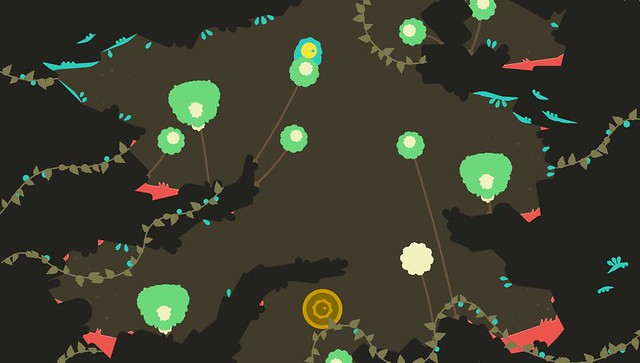
Sound Shapes -Really cute rhythm platformer for the Vita. Okay, you don't really have to have any sense of rhythm to play it (mostly timing... does that count as different?), but it's themed around collecting notes in a song that plays as you play. You can build your own levels too! Reminds me a little of Mutant Space Blobs Attack only more arty.


Indie Games
Long Live the Queen -A time management stat-cruncher! I loved the idea but I found it wasn't as flexible as Princess Maker 2 because it had kind of a story. I really liked how stats affects how you reacted to things, and how some of the classes (like foreign policy, a subcategory of history) seemed to be... really relevant for a queen-in-training. I might give it another go; the mood bonus system for learning actually requires quite a bit of planning.


The Sea Will Claim Everything -I've just been playing the generous demo but the free The Fabulous Screech will give you a good idea of the unique art style, point-and-click mechanics, and zany, Pratchett-like humor in a short, browser-based game. I love reading through the book names for gems like The Importance of Puns in the Release of Magical Energies, by Magister Erasmus of Zauberberg and The Voyage of the Darwin by Peter S. Beagle. Lana Polansky has played more of it and wrote a review praising its slower pace and political commentary.


Run -This experimental game has a soundtrack that's still running through my head! The story is a little weird, but I like that developers are messing around with how minigames can connect to each other.

What games are you playing this summer? Did you really hate a game I liked? Let me know in the comments!

*The deal with Amazon Affiliate links is that if you click an affiliate link, I'll get a 4% commission of anything you buy in the next 24 hours. I have no idea if it will make me any money, but I think it's worth a shot.

Friday, July 27, 2012

A videogame promoting moderation!?

The Act is a vidoegame about controlling your body language. It's experimental and accessible; short yet satisfying.

While so many other games promote extremes of being completely good or evil, killing everyone and finding everything, it's refreshing to see a game promote moderation. There's no correct dialogue option; you actually have to watch the faces of the NPCs to determine how you should act. Originally, the arcade game had a knob to twist your character from shy to gregarious, but the iOS port uses swipes.


A minute in and you can get a feel for the gameplay. The other amazing thing about this game is that it's all animated, old-school Disney-style. While there are some frustrating parts, overall, I was very impressed with the exploration of this new style of interaction. I'd love to see a body-language slider in an RPG, but given how intensive it is to animate, I might have to settle for tone brackets like (sarcastic) and (imploring).

Thursday, July 26, 2012

Jigsaw Puzzle Design: It's about being able to predict what pieces fit

I recently had the pleasure of putting together a wooden jigsaw puzzle. It was so much more fun than the old cardboard puzzles. I got to thinking about why cardboard puzzles suck and thought I could do a little analysis for you. 
Ravensburger puts out like a million of these
mini Japanese puzzle has even fewer piece types
This is from your typical cardboard puzzle. There are about six major piece types, and some rarer border and corner pieces. Since all the pieces look the same, you are pretty much stuck to looking at the colors on the pieces for figuring out where they go (oh, and the border-first thing). Having fun with this kind of puzzle relies heavily on having a diverse puzzle-picture, and having access to that picture. 

Wentworth puzzle
These pieces are from a puzzle I picked up in England. Since each piece's shape is very different from the others, it's possible to build this kind of puzzle by looking at the shapes alone. There are edge pieces, but some middle pieces also have straight edges. The pieces are wooden and have a satisfying feeling of fitting, unlike cardboard pieces where the cardboard gives a little even when you're putting together pieces that fit. There are still some conventional shapes, for which you can usually guess which way is up. Little "whimsy pieces" are shaped like things and it's easy to tell which pieces fit around them (for instance, you can see the silhouette of the horse-rider's head in one of the pieces here). 

the border is scalloped. This is a corner taken apart.
 This last puzzle I found the most devilishly clever. The pieces are all unique shapes, but they're similar in shape and are completely unpredictable in their orientations. Even the pieces surrounding the whimsy pieces weren't immediately apparent. For this reason I found that I was using all the available clues--shape, color, texture, whatever. It was even more satisfying to look at a piece and know it was exactly the piece I needed, before fitting it in (this rarely happens when I put together cardboard puzzles).

This moment of epiphany, when I could see the solution before enacting it, is crucial to a good puzzle game. It's the same feeling I get when I play falling-block games or things like Portal and Catherine. It's what makes puzzles fun for me. 
piece orientation is unpredictable. Artifact Jigsaw. 

Another aspect of jigsaw puzzles is that I've liked is that they're easily multiplayer. If someone else sees you working on a jigsaw puzzle, they can instantly tell how far you are and what kind of puzzle it is. Piecing together a puzzle isn't timed, and it's cooperative. You can start without having to wait for it to load and play for as short or as long as you like (if you're willing to re-do your puzzle). I haven't really found a puzzle game that's as good at multiplayer as a good old jigsaw puzzle.


Monday, July 23, 2012

Of tourism and game-playing

"I'm kind of doing a speed run of Journey," my husband, Adam, explained. For each complete run through of the game (up to... four times?), the decoration on your robe gets more elaborate. A speed run seemed like a logical way to enjoy the game a different way and get the cool robe addition. But yet, somehow a speedrun of Journey seems inimical to the game's aesthetics.

In the same way, my speedrun of England and Paris was completely typical of tourism, but I felt sometimes like I was missing the point of enjoying a new place, or any place. There is an urge to see all the vital sights--sights that, once seen, can be checked off a list; their countries stamped in one's passport. I'm very grateful that I had to opportunity to go to England and Paris, and I realize that everyone who writes feels the desire to write about their experiences abroad as if it is something new that no one else noticed. I know that my experiences are common. I submit that the common problems with tourism are also common to playing classic or popular videogames.
credit
At the Louvre, we must see the Mona Lisa, if only to say we've seen it. Her admirers petition her with cameras, increasing her immortality with each replication. I see other works I recognize; it's like seeing a celebrity, except it frequently looks exactly the same as your mental image does. Sure, the background details come out a bit better, and you can see the frame and the brushstrokes better, but everyone is in the same position. The glass pyramid looks as see-through as ever. Liberty Leading the People still has her breast exposed. And we must take a photo to show that we've been there. Or perhaps all these photos are so we can enjoy the details later, from the comfort of our homes. Taking photos becomes a way to relieve the anxiety that we aren't taking it all in--because maybe the camera is?


And of course, while I'm there at the Louvre, I'm thinking about the sights we'll see in the next few days, because these things must be planned--a simple pain of touring. After my speedrun of the Louvre, I didn't have time to go back and do a hardcore playthrough where I explored every hallway. My time and energy were spent.


Luckily, videogames have their entire world in their files. The anxiety isn't that we won't have the opportunity to see everything, but that we won't have time to beat them. Similarly, while playing one game, it's easy to think anxiously about its completion and what exciting game one will play after that one is done with. The text speed is impossibly slow and your character can't run fast enough. Playing the game becomes a chore.

You're familiar with this feeling. I'm trying to become more aware of it. When I feel like playing a game is a chore, I feel like I should stop playing it. But there's a balance to have here--some chores can be soothing in their repetition (like grinding), and sometimes pushing through a boring part of a game lets one enjoy its especially nice parts (like how even though walking seems impossibly slow in Dear Esther, getting to see the caves is completely worth it for the visual spectacle alone).

 Of course, there's a similar problem with tourism. Standing in line for over an hour at Versailles, I felt like tourism was a chore (a chore of the rich and privileged, but a chore nonetheless). But I felt like it was worth it to see the gaudy opulence that spurred a revolution and the stately, over-the-top gardens that went with it. I don't know how to balance being "in the moment" with "planning ahead so you don't get bored/stranded/waste time." But I do know it's a balance I strive for, in tourism, videogame playing, and in the rest of my life. I hope to explore Utah a little more--a place where I have the time and energy to do a "hardcore playthrough."


Thursday, June 7, 2012

Are videogames objects to analyze or experiences to have?


In any art there's a disconnect between "fun" and "analytic" mode. Recently I've been practicing to substitute for our church organist. Music at worship services is usually a spiritual experience for participants. My practicing, which is highly focused on finding where my fingers and feet should go so I can slip seamlessly between notes, has little room for spiritual thoughts. But I don't think all music performance has to be so detail-focused; if I were more proficient at the organ I might find it pleasant and uplifting.

On the other hand, all the self-criticism that enables my practice to actually improve my practice makes me a harsh critic when it comes to enjoying others' performances.

The same problem can apply to videogames. When a game is really difficult at first, it's not all that fun for me. But as I continue playing, I develop some mastery and the game becomes more fun, simply because I've learned a skill.

As I learn more about how games work, I get more critical about small details. In Warp, the rebound from releasing the analog stick sometimes causes the cursor to go in the opposite direction, causing my instadeath a few times. A rhythm game I recently played had no penalty for "wrong" key presses, making it really easy to get a high score through button mashing. Dragon Age has no option to skip combat and dialogue one has already seen after you've beaten the game (okay, I admit that one is a personal preference). If I'm too critical of a game, I'm enjoying it in a different way--as an object to dissect. Sometimes though, I just need to stop looking at games as objects and start looking at them as experiences.

Thursday, May 24, 2012

Bad quest design: Things changing because you talked to someone

I like that most of the quests in Dragon Age: Origins are pretty easy to figure out. Go kill some guys or put a red X on their doors and then you're done. I also like it when I need to gather information, but I feel like this just sets up a bad situation.

One example is finding the cartel in the dwarf town. The bandits who have the key you need don't show up in their little room until after you've talked to the lady who knows their leader. Before you talk to her, you can go inside and it's just an empty room. There seems to be no logical connection between talking to the woman and the bandits appearing other than quest progression. The same thing happens a LOT in Touch Detective. If I'm stuck in Touch Detective, it's because I haven't talked to everyone twice. Sometimes someone I'm supposed to talk to doesn't even appear until after I've talked to someone else. It's way frustrating.

I've identified this problem, but I'm not sure what a good solution would be. Have all the pieces of the puzzle laid out already, and risk the player encountering them out-of-order? Put a little exclamation point over someone you need to talk to? A request where you need to gather more information before proceeding makes sense. The thing we need to get rid of is the empty rooms changing unnoticed. But if every change is visible, it damages the conception of the game world as a place that is changing even when the player isn't looking (for some reason this is important, right?).

Thursday, May 17, 2012

Playing Dragon Age Origins!

Hey readers!  I'm going to start working as a part-time intern for the Killscreen, which is really close to my dream job! So I'm excited about that. I've already transcribed an interview, which doesn't sound glamorous, but it's still kind of fun to see the other side of a publication and be a part of that.

I wrote two articles for Nightmare Mode: an article on Journey's Parallels to the Mormon Temple Ceremony, and another on Pippinbarr's Pongs and how they criticize video game mechanics WITHIN a video game. I like writing for another site and working on an article until it's a lot better than something I'd just type out in an evening (like what I usually write here). But I still like the spontaneity of writing here. 

don't worry he is not actually as interesting as my husband
I started playing Dragon Age: Origins and I'm beginning to understand more of the Bioware fandom. I wanted to get Alistair to like my character, but in the process I ended up liking him more. I kind of like the dating sim part of the game! Sometimes the characters predictably like the "good" or "chaotic" choices, but you know, people in real life are like that sometimes. 

One thing I wasn't aware of was how the challenge scaling works in the game (basically, how the game determines how difficult the enemies are). I went to the big city as soon as I could, had difficulty beating the blood mages there, and just ratcheted the difficulty down so I could finish it, instead of figuring that I could come back when I was higher level. I thought it would work more like in Oblivion, but there's definitely an order that's best to follow for the enemies to match your level. I kind of wish I had stayed on the normal difficulty, but the casual difficulty is really easy and it's making it less likely for me to get stuck (and therefore I'm getting more time to spend on the parts of the game I like). Maybe it's going to injure my gamer cred, but oh well. Don't even worry, I'm going to get a grease/fire combo going at some point with my mage, even if I don't need to deal that much damage. 

I also regret leaving some things undone in Lothering (? that first town), not realizing it was going to be un-visitable with the encroaching blight. So I didn't get the bard or the prisoner dude in my party. I'm tempted to do another run through to do all the "bad" things (you know, like freeing the prisoner and making deals with demons) so I can see more of the story things. But I also want to get to Dragon Age 2! And all the other games on my shelf.  Those of you who have played DA:O, is it worth doing a second run?